
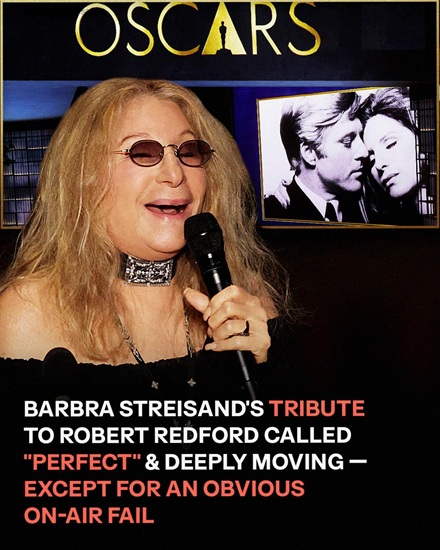
Barbra Streisand’s tribute to Robert Redford at the 98th Academy Awards was meant to be one of the most heartfelt and emotionally stirring moments of the evening, drawing attention from fans and Hollywood insiders alike.
The 83-year-old icon took the stage with grace, prepared to honor her former co-star and longtime friend while sharing memories that spanned decades of cinematic history and personal connection.
The tribute commemorated Redford, who passed away in September 2025 at the age of 89, reminding audiences of his extraordinary contributions to Hollywood as both a beloved actor and visionary filmmaker.
Streisand’s speech immediately evoked nostalgia, recalling their landmark collaboration in the 1973 romantic drama “The Way We Were,” a film that remains an enduring symbol of classic Hollywood romance and storytelling.
Streisand recounted the early days of the film, noting that when she first read the script, she could only envision Redford playing the role of Hubbell Gardiner.
Convincing him to accept the part, however, proved challenging, as he initially declined, believing the character lacked sufficient depth and backbone to carry the story effectively on screen.

After several script revisions and negotiations, Redford ultimately agreed to take the role, and the film became one of Hollywood’s most celebrated romantic dramas.
Streisand shared these anecdotes with warmth and humor, offering fans a rare glimpse into the professional dynamics and creative discussions that shaped one of cinema’s most memorable love stories.
The performer also shared personal memories that highlighted their longstanding bond, such as Redford affectionately calling her “Babs.” Streisand joked about the nickname, asking playfully, “Do I look like a Babs?”—a small anecdote that brought laughter to the audience while revealing the playful nature of their friendship behind the camera.
She concluded the tribute by recalling their final exchange before Redford’s passing, a moment that underscored the depth of their connection. “Babs, I love you dearly and I always will,” Redford once said during a phone conversation, to which Streisand responded in kind, signing off her last note with the affectionate moniker that had defined their friendship.
Social media immediately reacted to the tribute, with viewers praising its heartfelt nature while also noticing a technical issue. Some fans commented on Instagram, expressing admiration and emotional resonance, writing, “Had me in tears. Beautiful Tribute 💙✨” and “A beautiful tribute from Barbra❤️❤️❤️❤️❤️.”
However, a separate conversation emerged online regarding the background music, which some viewers felt was overly loud and sometimes drowned out Streisand’s words.
Commenters noted that the piano accompaniment occasionally overtook her speech, making it difficult to hear the singer’s heartfelt anecdotes and reflections on Redford’s life and career.

On Facebook, multiple viewers expressed frustration with the audio balance, writing things like, “The piano was overtaking her speech,” and “They should have cut the music and let her speak. It wasn’t background music; it was overwhelming,” highlighting the challenges of live televised tributes.
Despite the minor technical issues, Streisand’s tribute remained one of the night’s most discussed and memorable segments. Fans and critics alike praised her poise, emotional depth, and ability to convey both personal affection and professional respect in a performance watched by millions across the globe.
In an unexpected twist, actress Jane Fonda offered a candid reaction during a post-ceremony red carpet interview, sparking further online discussion. While praising Redford and noting his influence on Hollywood, Fonda jokingly questioned why Streisand had been chosen to deliver the tribute, highlighting the playful and sometimes provocative dynamics among Hollywood legends.
Fonda acknowledged her own admiration for Redford, recalling their multiple collaborations and expressing affection for his charm, talent, and influence. Her comments added context to Streisand’s tribute, emphasizing the complex web of personal and professional relationships that define Hollywood history and cinematic legacy.
Streisand’s reflection on Redford also prompted speculation about whether this would be her final major performance. Sources reported that she has been highly self-critical about her vocal performance, revisiting recordings and noting that her voice “isn’t what it once was,” suggesting a desire to preserve her legacy at its peak rather than risk public comparison to her younger self.
The EGOT-winning performer reportedly has no plans to return to the stage purely for financial reasons, as decades of success have left her focused on legacy preservation rather than public acclaim. Fans are encouraged to appreciate this tribute as a poignant culmination of her illustrious performing career.
The personal bond between Barbra Streisand and Robert Redford extended far beyond the cameras and scripts of Hollywood.

Behind the scenes of “The Way We Were,” they developed a deep, complex connection that blended professional respect with moments of playful tension, creating a dynamic that added intensity to their on-screen chemistry and captivated audiences for decades.
Streisand has recounted how, during the initial script readings, she immediately envisioned Redford in the role of Hubbell Gardiner, but convincing him to accept proved challenging due to his reservations about the character’s depth. This negotiation process reflected both Redford’s careful approach to his craft and Streisand’s determination to see their collaborative vision come to life.
Their contrasting backgrounds added an intriguing dimension to their relationship. Streisand, raised in Brooklyn within a tight-knit Jewish family, grew up immersed in city life and culture, while Redford, a California native, embodied a more laid-back, Western sensibility.
Yet, these differences only strengthened their curiosity about each other, allowing them to develop a connection that went beyond typical Hollywood partnerships.
Over time, Streisand admitted to misjudging Redford upon first meeting him, assuming his cool demeanor might signal disinterest. In reality, Redford maintained professional distance while simultaneously fostering trust and collaboration, allowing Streisand to see his dedication, intelligence, and unique approach to acting and storytelling.
Reports and biographies, including Robert Hofler’s “The Way They Were: How Epic Battles and Bruised Egos Brought a Classic Hollywood Love Story to the Screen,” reveal the tensions and challenges they faced on set.
Allegedly, Redford initially questioned Streisand’s ability to carry the emotional weight of her character, while Streisand quickly found herself attracted to his charm and charisma, creating a subtle push-pull dynamic.
Even seemingly mundane aspects of filming became sources of tension and comedy. For instance, love scenes were choreographed with extreme care: Redford wore two pairs of underwear, while Streisand opted for a bikini, ensuring boundaries were maintained while preserving the authenticity of their performances. These precautions added layers of complexity and humor to the filming process.
Despite these awkward, professional boundaries, the underlying chemistry between Streisand and Redford captivated audiences. Their contrasting personalities—her intensity and expressiveness paired with his calm and composed demeanor—created memorable tension that translated beautifully on screen, helping the film achieve lasting cinematic impact.
After the release of “The Way We Were,” the film became a critical and commercial success, solidifying both actors’ legacies. Streisand received accolades for her performance, including an Academy Award, while Redford continued to be celebrated for his nuanced and captivating portrayal of Hubbell Gardiner, demonstrating the enduring power of their collaboration.

Years later, Streisand reflected on the possibility of a sequel, expressing enthusiasm and fondness for revisiting the characters, while Redford showed no interest in reprising the role, signaling the end of their on-screen partnership.
This divergence in perspective highlighted their individual priorities and approaches to legacy, as well as the complexities of navigating both professional and personal relationships in Hollywood.
Beyond their professional achievements, Streisand and Redford cultivated rich personal lives. Streisand married James Brolin, blending families and creating a close-knit household, while Redford, previously married to Lola Van Wagenen, devoted much of his later life to family and philanthropy.
Their shared experiences illustrate how two legendary figures balanced fame, personal growth, and legacy over decades of public attention.
The Oscars tribute served not only as a commemoration of Robert Redford’s life but also as a reflective moment for Barbra Streisand herself, reminding audiences of the enduring impact of their shared cinematic history and personal connection. Her carefully chosen words captured both professional admiration and heartfelt affection.
Redford’s passing in September 2025 marked the end of an era, as the legendary actor and filmmaker had long been celebrated as a symbol of Hollywood’s golden age and a pioneer in independent cinema. His contributions extended beyond acting, encompassing visionary directing, producing, and philanthropic endeavors that influenced generations of filmmakers and audiences worldwide.
Streisand’s delivery of the tribute reflected decades of professional experience and personal insight, blending warmth, humor, and nostalgia into a speech that reminded viewers of the rare chemistry and mutual respect that defined their collaboration. Each anecdote was carefully selected to evoke memory and emotion, highlighting their off-screen bond as much as their on-screen magic.
The live audience reacted with rapt attention, as Streisand recounted intimate moments with Redford, such as his affectionate nickname for her, their playful interactions, and the creative exchanges that occurred during filming. Her ability to convey authenticity in a highly public setting underscored the depth of their friendship and artistic partnership.
Meanwhile, viewers at home immediately took to social media, sharing clips, screenshots, and reflections. The tribute prompted discussion not only about the emotional content but also about the technical aspects of the performance, with some noting that background music occasionally overshadowed her voice, sparking debates about live sound mixing at award shows.

Despite minor audio distractions, the tribute achieved its intended effect: celebrating Redford’s legacy, honoring his contributions, and providing a humanizing, intimate look at the bond between two Hollywood icons. Streisand’s ability to balance emotion, storytelling, and professionalism captivated both live and virtual audiences.
The Oscars moment also highlighted Streisand’s broader legacy as an entertainer. Having achieved EGOT status, she remains a towering figure across music, Broadway, and film, with decades of awards, groundbreaking performances, and innovative artistic choices demonstrating a lifelong commitment to excellence and creative integrity.
In reflecting on Redford, Streisand also offered insight into the human side of Hollywood stardom: the humor, the tension, the misunderstandings, and the private moments that rarely reach the public eye. Her anecdotes about script negotiations, creative disagreements, and playful banter added texture to the narrative, emphasizing the complexity of celebrity relationships.
Redford’s own life mirrored these themes of balance and legacy. Despite his fame, he prioritized family, philanthropy, and mentorship, creating a multifaceted career that extended beyond box office success. His children continued aspects of his cinematic vision, and his dedication to independent filmmaking left a lasting influence on the industry’s evolution.
The combination of Streisand’s heartfelt tribute and Redford’s enduring legacy created a powerful emotional resonance, reinforcing the cultural significance of both figures. For viewers, the moment encapsulated the best of Hollywood storytelling, merging history, artistry, and genuine human connection into a single, unforgettable segment of the Oscars broadcast.
Finally, the tribute was widely acknowledged as a fitting final curtain call for Redford’s public career, celebrating a life defined by artistic achievement, personal integrity, and timeless charm. Streisand’s presence on stage ensured that the memory of their collaboration—and Redford’s profound impact—would be remembered by both fans and fellow industry professionals for years to come.
As the audience and millions of viewers reflected on the speech, it became clear that Streisand’s tribute was not just a performance but a historical moment, a bridge between Hollywood’s golden past and the contemporary film landscape, preserving the legacy of Robert Redford while highlighting the enduring artistry of Barbra Streisand.
