
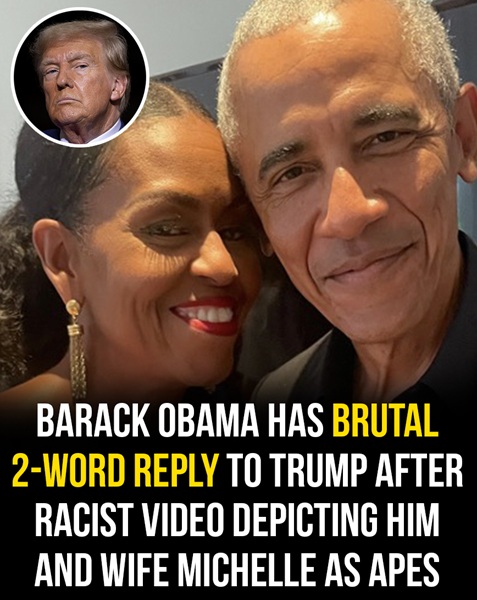
In early February 2026, the United States witnessed a moment in its political discourse that was brief in duration but immense in impact.
A single post, shared on President Donald Trump’s Truth Social account — a platform he has consistently used to communicate directly with his base and bypass traditional media channels.
Ignited a storm of national attention, bringing questions of race, civility, and presidential conduct to the forefront of public debate.
The post in question appeared late on the evening of February 5, 2026. Truth Social, launched in 2022 as an alternative social media platform catering to conservative users, has increasingly been a site where the former president could post content unfiltered by the constraints of traditional news outlets or content moderation policies of larger platforms.
On this particular night, the content included a video that mixed claims about the integrity of the 2020 presidential election with various clips, animations, and images intended, according to some supporters, as political commentary. However, within the roughly one-minute video, there was a moment that transcended standard political debate: a brief segment in which former President Barack Obama and former First Lady Michelle Obama’s faces were digitally superimposed onto animated ape bodies.

This visual was paired with the music of “The Lion Sleeps Tonight,” creating a combination that many interpreted as invoking one of the most pernicious and historically racist tropes in American history: comparing Black individuals to primates.
The clip remained on the platform for approximately twelve hours before being removed by White House staff following a surge of criticism from across the political spectrum. The rapidity of both dissemination and reaction underscored the powerful role social media now plays in shaping public perception, political narratives, and national conversation.
The Political and Social Context
The significance of this moment cannot be divorced from its historical and social context. Comparisons of Black people to apes have been used for centuries in the United States as a tool of dehumanization — a way to justify systemic oppression, segregation, and violence. From racist caricatures in 19th- and 20th-century publications to the imagery employed in political propaganda, this trope has caused enduring harm and reinforced social hierarchies based on race.
Against this backdrop, the posting of such imagery by the sitting president — even in a digitally altered, ostensibly humorous form — was immediately recognized by many as profoundly offensive. It revived long-standing wounds and underscored how digital media can amplify harmful stereotypes to millions within minutes.
This episode also intersected with broader tensions in American politics at the time. The country remained sharply divided along partisan lines, and the 2020 election and its aftermath continued to be a flashpoint for debate. Truth Social, as a platform associated closely with former President Trump, had become both a conduit for supporters to access unfiltered messaging and a site of controversy when content posted there sparked outrage. The platform’s structure — prioritizing engagement among a highly partisan audience — meant that provocative or incendiary content could achieve widespread attention quickly, even without the approval or awareness of the original poster.
Immediate Reactions and Criticism
The response was swift and bipartisan. Prominent journalists, advocacy organizations, civil rights leaders, and citizens voiced outrage at the post. What some users dismissed as a joke or political satire was widely interpreted as a deliberate evocation of racist imagery.
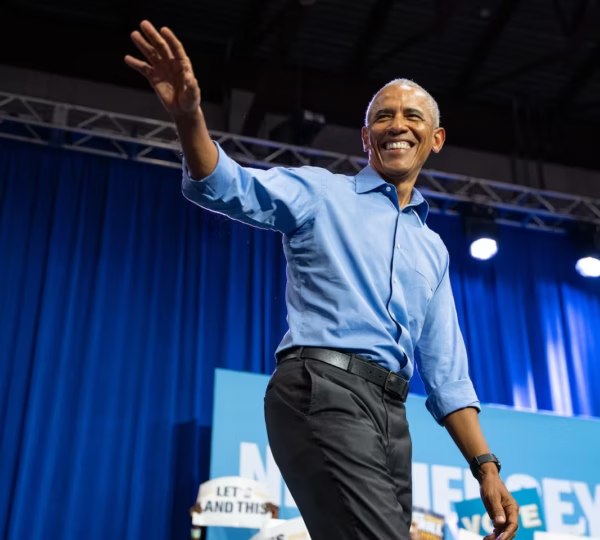
One particularly notable reaction came from Republican Senator Tim Scott of South Carolina, who publicly condemned the depiction as “the most racist thing I’ve seen out of this White House.” Scott’s rebuke was striking because it represented a clear divergence from the prevailing narrative among many of the president’s allies, signaling that even within the Republican Party, there were boundaries regarding the use of racially charged imagery.
Democratic leaders, civil rights advocates, and independent commentators also condemned the post. California Governor Gavin Newsom called the imagery “disgraceful,” emphasizing that it violated basic norms of decency and respect. Advocacy groups, including the NAACP and Color of Change, issued statements highlighting the enduring harm of comparing Black individuals to animals and noting the dangers of such imagery appearing in content disseminated by the nation’s highest office.
Within hours, social media platforms outside of Truth Social amplified the controversy. News outlets ranging from CNN and MSNBC to Fox News and the Associated Press covered the story extensively, examining both the video’s content and the implications for presidential conduct, race relations, and online discourse. Commentators dissected the animation, the musical accompaniment, and the potential motivations behind the post, noting how a few seconds of digital imagery could spark a national conversation about history, respect, and societal values.
The White House Response
Initially, the White House sought to downplay the controversy. Press Secretary Karoline Leavitt described the criticism as “fake outrage,” framing the clip as an internet meme in which President Trump was portrayed as “King of the Jungle.” She suggested that media attention was disproportionate to the intent of the post, telling entertainment outlet TMZ that critics should “report on something that actually matters to the American public.”
As backlash intensified and coverage proliferated, aides eventually removed the video. The White House claimed it had been posted by an unnamed staffer in error. While this explanation mitigated some immediate pressure, the absence of an apology from President Trump himself drew further criticism. He insisted publicly that the video was part of a larger discussion about election integrity and that he bore no personal culpability for the offensive imagery.
Despite the technical removal of the post, the incident left lasting impressions. Screenshots and clips circulated widely across the internet, shared on social media, news platforms, and private messaging apps. Once digital content enters the public domain, its removal rarely erases its influence.
Historical Resonance and Public Discourse
The episode forced Americans to confront uncomfortable truths about race, media, and politics. Historians and cultural commentators contextualized the imagery within a long lineage of racist caricature, explaining how even brief depictions can resonate deeply due to historical memory. Political scientists highlighted the role of social media in magnifying both the impact and the consequences of presidential messaging.

Observers noted that the incident exemplified a broader decline in decorum and civility within political discourse. While political leaders have long used symbolism, satire, and provocative imagery to make points, there exists a social expectation — particularly for high office holders — that racialized dehumanization is unacceptable. By invoking such imagery, even digitally altered and ostensibly humorous, the post violated these norms, sparking debate about the responsibilities of public figures in shaping national conversation.
This initial part of the controversy sets the stage for the deeper implications that would unfold in the following days, including the responses from former President Barack Obama, broader public discourse about race and media, and the lasting political and social ramifications of the episode.
For several days after the removal of the video from Truth Social, neither former President Barack Obama nor his family issued an immediate response. This silence, deliberate or circumstantial, allowed the incident to continue circulating across social media, news sites, and private conversations. Analysts noted that the pause reflected both a careful media strategy and the complexity of responding to a racially charged incident without inflaming partisanship further.
On February 14, 2026, Barack Obama broke this silence during a wide-reaching interview with political commentator Brian Tyler Cohen. The interview quickly gained national attention, shared across television, social media, and online news outlets. Obama’s comments were measured but unambiguous, emphasizing the dual realities of historical context and contemporary political climate.
Obama’s Analysis of the Incident
Obama began by acknowledging the specific offense of the video: the depiction of him and Michelle Obama as apes. He described the imagery as “deeply troubling,” situating it within a historical continuum of racist representations. He stressed that these portrayals are not neutral or harmless, but rather part of a long-standing visual language designed to dehumanize Black people, strip dignity, and justify exclusion or oppression.

“It’s important to recognize that the majority of the American people find this behavior deeply troubling,” Obama explained. “It reflects a broader decline in how we communicate with one another as a society, and the erosion of the norms that once guided our public discourse.”
During the interview, Obama did not limit himself to denouncing the imagery; he used the opportunity to reflect on broader political and social dynamics. He noted the rise of social media as a primary forum for political messaging, emphasizing that the speed and virality of digital content amplify both its reach and its potential harm. He highlighted how platforms like Truth Social, X (formerly Twitter), and others have become arenas where provocative content often overshadows substantive discussion, creating incentives for shock, outrage, and viral engagement.
“These platforms are not inherently bad,” Obama said, “but the algorithms that govern them reward content that gets clicks, shares, and reactions — not necessarily content that is truthful, thoughtful, or respectful.” He observed that in such an environment, even a brief digital clip can become a flashpoint, shaping public perception and amplifying historical wounds.
Reflections on Civility, Decorum, and Leadership
Central to Obama’s remarks was a reflection on civility and the standards of public conduct. He argued that in prior generations, public officials, particularly presidents, operated within an understood framework of respect, decorum, and dignity — norms designed to maintain public trust, protect institutions, and ensure that debate remained substantive rather than personal or dehumanizing.
“Historically,” Obama noted, “there were expectations — not just about what leaders could say publicly, but also about what they symbolized. The office itself carried an obligation to foster unity, or at the very least, refrain from actions that deliberately inflame division.”
He described a growing concern that these norms have eroded, leaving room for content that many Americans perceive as offensive, harmful, or demeaning. “There doesn’t seem to be any shame about this anymore,” he observed. “We see people using shock, outrage, and provocation as political tools, often at the expense of the dignity of others.”
Obama framed his comments within a broader philosophical context, highlighting the importance of shared societal values. He stressed that while robust debate and disagreement are central to democracy, they must be tempered by respect for fellow citizens, sensitivity to historical context, and adherence to basic principles of human dignity.
Racial Implications and Public Memory
The racial dimension of the video, Obama emphasized, cannot be separated from America’s historical memory. Comparing Black individuals to apes is not merely offensive in a personal sense; it is tied to centuries of systemic racism, including slavery, segregation, and media propaganda. Such imagery has been used to justify exclusion from political participation, economic opportunities, and social recognition.
Obama noted that even brief or seemingly satirical digital depictions can resonate powerfully because of this historical legacy. “Symbols carry weight,” he said. “They evoke memory, fear, pride, and pain. And leaders — especially those who have held or aspire to hold office — have a responsibility to understand that weight and exercise restraint.”
He also observed the emotional impact of viral content on everyday Americans. While political elites often view such content strategically, the broader public encounters it in personal contexts: on social media feeds, in news summaries, and in conversations among family and friends. “For young people, for children, for those who have experienced discrimination or marginalization,” Obama said, “these images are not abstract; they are real, and they affect the way people see themselves and others.”
Linking Race, Social Media, and Democracy
Obama further explored the intersection of race, media, and democratic governance. He cautioned that when racialized content is amplified by influential figures, it risks normalizing disrespect and reinforcing divisions. The social consequences extend beyond immediate outrage: they can influence civic trust, voter engagement, and public understanding of social norms.

“The responsibility of leadership extends beyond policy,” Obama asserted. “It includes setting an example for discourse, demonstrating respect for difference, and signaling that our shared humanity is paramount.” He contrasted this with a digital culture in which provocation and viral potential often overshadow consideration for historical context, ethical responsibility, or factual accuracy.
He concluded this portion of the discussion by acknowledging the resilience of the American public. Despite the proliferation of sensationalized and sometimes offensive content, he maintained that many Americans continue to value decency, kindness, and mutual respect. “When you travel around the country,” he said, “you meet people who still believe in civility. They still believe in common decency, courtesy, and human kindness — and that belief matters more than the latest viral outrage.”
Once the video depicting Barack and Michelle Obama as cartoon apes went viral, the public reaction was swift, intense, and multifaceted. Across the United States, journalists, advocacy groups, political analysts, and ordinary citizens engaged in a heated discussion about the incident, the responsibilities of public figures, and the influence of social media in shaping national discourse.
Immediate Public Backlash
Within hours of the video’s appearance, outrage spread across multiple platforms. Twitter threads, news comment sections, and online forums filled with commentary condemning the content. Many users emphasized the historical racism inherent in the imagery, highlighting the centuries-old trope of comparing Black individuals to primates — a harmful stereotype used to justify systemic oppression and dehumanization.
Civil rights organizations, including the NAACP and Color of Change, issued formal statements calling the imagery offensive and unacceptable. They urged immediate removal of the content and demanded accountability from both the platform and the sitting president.
Prominent political figures across party lines also weighed in. Democratic leaders quickly condemned the post, framing it as a blatant act of racial insensitivity. Republican leaders were divided: some, like Senator Tim Scott, publicly criticized the content and called for its removal, signaling that even within the party there were limits to what behavior was acceptable for elected officials. Others downplayed the controversy, framing it as an unfortunate joke or a misjudged staff error.
The White House initially defended the post as part of a larger video discussing election integrity and denied any intention to offend. Press Secretary Karoline Leavitt described the backlash as “overblown outrage” and suggested that the public focus should be on substantive policy issues rather than viral moments. However, the defense did little to quell the intense criticism from media, civil rights groups, and large segments of the general public.
Media Coverage and Analysis
National media outlets provided extensive coverage, analyzing both the content and its social implications. Reporters noted the brevity of the clip — roughly a single second in a video that primarily addressed alleged voter fraud claims from the 2020 election — yet highlighted the outsized impact of that one moment. Analysts explained that images conveying racialized stereotypes have an outsized capacity to provoke emotional responses and shape public perceptions, even when the intention behind their use is disputed.
Editorial commentary emphasized the intersection of race, politics, and technology. The Obamas’ depiction was more than an isolated incident; it represented the increasing prevalence of visual content on social media platforms that can rapidly influence public discourse. Media experts noted that the combination of virality, algorithm-driven amplification, and political notoriety created a scenario in which a single visual could dominate news cycles, compel official responses, and spark nationwide conversations.
Social Media Dynamics
The episode highlighted the evolving role of social media in political communication. Platforms like Truth Social, X (formerly Twitter), and Threads provide direct lines of communication between leaders and the public. While this immediacy allows for unfiltered messaging, it also increases the risk that harmful or offensive content can reach millions within minutes.
Digital analysts explained that social media algorithms favor engagement — likes, shares, comments — over content quality or historical context. As a result, provocative imagery, particularly when tied to a high-profile figure, often achieves rapid distribution and wide visibility. In this case, the combination of a viral video and a racially charged trope created a perfect storm for national attention.
Observers noted that while platforms can remove content or issue disclaimers, the initial spread of misinformation or offensive imagery is difficult to fully retract. Even after the clip’s deletion, screenshots, reuploads, and discussions ensured that the content continued circulating, amplifying its social and political impact.
Political Implications
The controversy also had significant political ramifications. Analysts emphasized several points:
- Polarization and Partisan Perceptions: Responses to the video were predictably polarized. Supporters of President Trump often framed the backlash as exaggerated, while opponents emphasized the ethical and historical severity of the imagery. The episode illustrated the deep divisions in contemporary political discourse and underscored how symbolic acts can serve as catalysts for broader ideological debate.
- Leadership and Cultural Responsibility: Public criticism focused on the role of leaders as cultural exemplars. High-profile figures, especially presidents, have an amplified ability to influence societal norms. By posting racially offensive content, even indirectly, a leader can inadvertently signal tolerance for dehumanizing language or imagery, affecting not only public perception but also civic culture.
- Social Media as Political Tool: The incident sparked discussion about how social media platforms are weaponized for rapid political messaging. While direct communication can democratize information, it also bypasses traditional checks on content appropriateness, amplifying both intentional and unintentional harms.
- Bipartisan Lessons: Republican and Democratic reactions demonstrated that certain boundaries — racial respect, human dignity, civility — remain broadly acknowledged across political lines, even amid deep polarization. The incident provided an opportunity for bipartisan dialogue on standards for leadership and communication.
Public Reflection and Civic Engagement
Beyond political leaders and media analysts, ordinary Americans engaged in reflection and debate. Town halls, community forums, and online commentaries explored the ethical responsibilities of leaders, the long-term consequences of racialized messaging, and the importance of maintaining respect in public discourse. Civic educators used the moment as a case study, demonstrating how media literacy, historical awareness, and critical thinking are vital for navigating modern political communication.
Historians contextualized the imagery within the broader history of racial representation in the United States, noting that such depictions are not harmless entertainment but carry deep social and psychological consequences. Sociologists highlighted how viral moments like this affect collective memory, influence identity formation, and shape societal norms for generations.
Lessons and the Path Forward
The controversy sparked ongoing conversations about the responsibilities of public figures, the ethical use of social media, and the boundaries of political expression. Several key lessons emerged:
- Awareness of Historical Context: Public figures must recognize that imagery and language carry historical weight, particularly when they reference racialized stereotypes.
- Civic Responsibility: Leaders’ words and actions set precedents. Even brief digital content can signal broader tolerance for dehumanization if not addressed responsibly.
- Media Literacy: Citizens need tools to critically evaluate content, understand its implications, and distinguish between provocation, misinformation, and legitimate discourse.
- Bipartisan Standards of Decency: Despite political divides, fundamental expectations of respect, civility, and dignity remain shared values that should guide national conversation.
- Social Media Accountability: Platforms must balance freedom of expression with mechanisms that prevent amplification of harmful, historically loaded, or misleading content.
Conclusion
The February 2026 video incident was more than a momentary controversy; it became a lens through which Americans examined the state of their democracy, civic culture, and shared values. Barack Obama’s response, emphasizing the importance of decency, historical awareness, and responsible discourse, underscored the need for reflection beyond partisan outrage.
By analyzing the episode’s origins, dissemination, and reception, the public was forced to confront the power of social media, the responsibilities of leadership, and the ongoing challenges of racial equity and civic integrity.
Ultimately, the incident illustrates that even in a polarized era, ethical norms, historical consciousness, and public accountability remain vital. Citizens, media, and leaders alike bear responsibility for upholding the principles of respect, civility, and truth in political and cultural life — a lesson that resonates far beyond any single viral post.
