
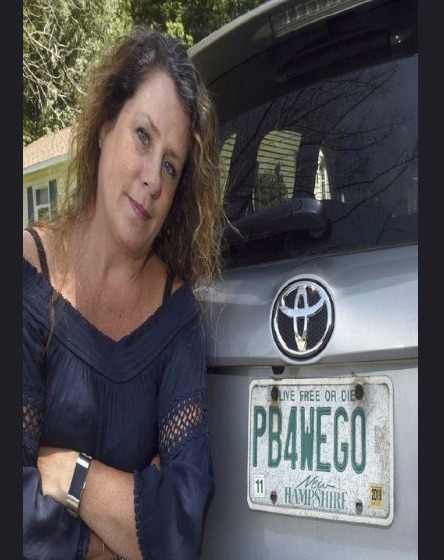
A New Hampshire mother was recently surprised and frustrated when the state’s Division of Motor Vehicles demanded she give up a personalized license plate she had cherished for more than fifteen years.
A plate that held special meaning for her and her children. The woman, Wendy Auger of Rochester, New Hampshire.
Had chosen the vanity plate “PB4WEGO” long ago as a humorous everyday reminder to her sons to “pee before we go” whenever they left the house for errands or trips.
For more than a decade and a half, the plate brought smiles and laughs, quickly becoming a small but distinctive part of the family’s daily routine and identity, drawing compliments from neighbors and fellow drivers.
Auger’s longtime plate suddenly drew official scrutiny in 2019, when she received a letter from the state’s Division of Motor Vehicles instructing her to surrender it because the letter combination was deemed inappropriate under state rules.

The DMV claimed the plate’s letters could be interpreted as referring to bodily functions, including “excretory acts or functions,” language cited in the letter as justification for revoking the vanity plate she had enjoyed for so long.
According to the DMV’s letter, Auger had ten days to turn in “PB4WEGO” to the state or select another custom plate at no additional cost, a timeline that caught her by surprise given how long she had used the plate without issue.
Auger has four children, and the license plate’s message was simply a lighthearted parental reminder, not meant to offend or shock anyone; it was a familiar phrase many parents use in everyday conversation.
“It would just stink if I don’t have it anymore,” Auger joked in interviews, using humor to underscore how commonplace the reminder was for her family and others who often said the same phrase.
She also highlighted the irony that this demand came from a state whose official motto is “Live Free or Die,” a slogan appearing on all New Hampshire license plates and emphasizing personal freedom and expression.
Auger is a paralegal by profession, and she told reporters she was not trying to start a political or cultural fight, but simply wanted to keep something that was personal, harmless, and meaningful to her family.

Shortly after receiving the recall notice, Auger posted a photo of her license plate and the DMV demand letter on Facebook, where her story quickly gained viral attention as readers shared humor, support, and disbelief.
Many social media users called the situation “ridiculous,” noting that the plate was funny and relatable, with commenters describing how they, too, had said similar things to children before leaving the house.
One person wrote, “Such a ridiculous situation… Not only is it funny and cute, it’s a really good reminder!” while another asked with disbelief, “What’s going on?! You’ve had that plate forever!”
Others suggested playful alternatives, such as replacing the plate with another jokey phrase like “PEE OR DIE” or even “DMV SUX,” reflecting how widely the plate had resonated with humor and everyday parenting.
Auger herself responded to supporters with humor, saying at one point, “Live free or die my arse,” a quip that blended the state motto with her frustration over the DMV’s interpretation of the plate.
Despite her lighthearted approach, Auger took the DMV letter seriously and began the process of appealing the decision, preparing to argue that the plate’s intent was innocent and that many drivers understood the fun meaning.
The story drew local media coverage as well as national attention, with news outlets highlighting the unusual clash between regulatory rules and everyday language that many families used without controversy.
State rules governing vanity plates were tightened in the wake of a 2014 New Hampshire Supreme Court decision that found overly broad bans on offensive language were too vague, prompting more explicit definitions of what could or could not be displayed.

Under the revised DMV guidelines, references to bodily functions and excretory language — even in innocuous contexts — were prohibited on personalized plates, a policy that resulted in the recall notice for Auger’s familiar combination.
The strict enforcement of these guidelines sparked debate among residents, some arguing that the policy was too rigid and failed to consider context, humor, or the intent behind the words chosen by drivers.
As the controversy continued to grow, the story eventually reached the attention of New Hampshire Governor Chris Sununu, who personally intervened after hearing about the dispute between Auger and the state DMV.
Gov. Sununu called DMV officials and urged them to reconsider their decision, explaining that the plate was widely seen as a benign, family‑friendly reminder rather than something offensive or inappropriate.
In a message to Auger, the governor acknowledged that the process had been a bureaucratic hurdle and said that “common sense prevailed” in the ultimate resolution, a sentiment that brought relief to many supporters.
Sununu’s intervention led to a reversal of the DMV’s decision, allowing Auger to keep her long‑beloved vanity plate and sending a message that context and intent should matter when interpreting personalized phrases.
On August 28, 2019, Auger took to Facebook again to announce her victory, posting excitedly that “This Sassy Momma Has Her Plates!!!” and sharing her gratitude with the network of supporters who had followed her story.
The governor’s decision was widely praised by commenters and observers who felt that a phrase reminding children to use the restroom before a car ride was harmless, funny, and clearly understood by most drivers.
The episode illustrated how personalized plates, intended as expressions of individuality, family identity, or humor, can sometimes come into conflict with administrative language policies that lack nuance or context.
Many commentators noted that the DMV’s interpretation seemed out of touch with everyday language, especially when the phrase reflected a common parenting practice embraced by drivers across the country.
Auger’s case also sparked broader conversations about freedom of expression, the purpose of vanity plates, and the balance between regulatory standards and individual choice in how people personalize their vehicles.
Some critics argued that the state’s policy should be revisited to allow more flexibility and common‑sense interpretation, suggesting that enforcement should focus on truly offensive expressions rather than benign or humorous ones.
Others pointed out that the DMV’s initial decision was likely the result of strict internal guidelines designed to prevent genuinely inappropriate language from appearing on license plates, even if that led to overreach.
The reversal of the ruling showed that public engagement and attention can influence administrative decisions, particularly when a broad audience sees a story as emblematic of everyday language and humor.
Auger’s case resonated with parents, drivers, and readers nationwide because the underlying message — encouraging children to take care of basic needs before travel — was universally understood and widely practiced.
Following the governor’s announcement, many supporters celebrated Auger’s win, noting that a simple phrase that brought joy and relatability should not have been subject to bureaucratic removal.
The outcome was a reminder that policies governing personal expression should take into account context, intent, and how language is commonly used, especially when rules affect ordinary citizens in their daily lives.
License plates continue to serve as a form of personalization for drivers, allowing people to share messages that are meaningful, humorous, or reflective of their identities, as long as they comply with reasonable standards.
In the months that followed, Auger continued to enjoy reactions from other motorists who spotted her “PB4WEGO” plate, with many honking, smiling, or taking photos because they recognized the message themselves.
The story remains one of the more memorable examples of how a light‑hearted family motto intersected with government regulation, and how community support and common sense ultimately guided a fair resolution.
Many New Hampshire residents and observers outside the state continue to cite the episode when discussing personalization, free expression, and the importance of judging language in context rather than by isolated letter combinations.
Events like this often shape conversations about how government agencies interpret rules, reminding officials and citizens alike that flexibility and understanding are important when policies touch everyday life.
For Auger, keeping her license plate wasn’t just about a message on the back of her car — it was about preserving a part of her family’s story and a playful reminder that resonates with countless parents everywhere.
Whether seen as humor, nostalgia, or a helpful cue for her children, the “PB4WEGO” plate now stands as a symbol of everyday language, parental routine, and the victory of common sense over bureaucratic misunderstanding.
In the end, the episode brought laughter, reflection, and conversation, showing that even a small personalized plate can carry meaning well beyond its few characters, connecting drivers through shared experience and everyday life.
