
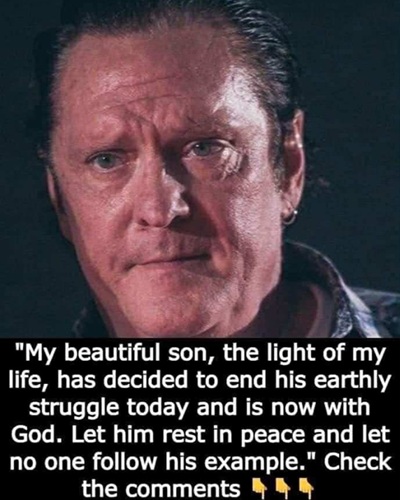
The final text message Michael Madsen ever received from his eldest son, Hudson, was heartbreakingly simple, yet profoundly weighty:
“I love you dad.” In those four words, there was warmth, affection, and the quiet intimacy of a bond between father and son—nothing that hinted at the tragedy looming in the days to come.
For Michael Madsen, the veteran actor whose career spans decades and includes iconic roles in Reservoir Dogs, Kill Bill, and Once Upon a Time in Hollywood, these words became a haunting echo of a loss that no parent should ever endure.
Hudson Madsen was not merely the child of a Hollywood figure. At 26, he had built a life of his own, grounded in service, responsibility, and dedication. A U.S. Army Sergeant, he had recently completed his first tour of duty and was stationed at a military base in Hawaii.
Colleagues and friends described Hudson as thoughtful, disciplined, and deeply devoted to those he loved. His demeanor reflected a combination of quiet strength and kindness—a young man who had chosen a path of commitment over fame, service over celebrity.

On January 22, 2022, tragedy struck in the form of a suicide that left Michael Madsen and his family reeling. The news sent shockwaves through the actor’s inner circle and the wider public, bringing an intense spotlight to the Madsen family’s grief. In interviews, Michael Madsen candidly admitted his disbelief. “I didn’t see any signs of depression,” he told the Los Angeles Times. “It’s so tragic and sad. I’m just trying to make sense of everything and understand what happened.”
The suddenness of Hudson’s death magnified the anguish. For any parent, the loss of a child is devastating; when there are no clear warning signs, the grief can feel insurmountable. Hudson was Michael’s eldest child with his wife, DeAnna Madsen, and older brother to Kalvin and Luke.
From a previous marriage to Jeannine Bisignano, Michael also has two sons, Christian and Max. Hudson grew up surrounded by a world of creativity, film sets, and Hollywood culture, yet he consciously pursued a very different life trajectory. He sought service and purpose through the military rather than the limelight, a decision that spoke volumes about his character and sense of duty.
Hudson’s life was multifaceted. Beyond his military career, he had recently nurtured a personal life with his wife, Carlie, whom he married in 2019. The couple appeared deeply connected, and Carlie often shared glimpses of their life together on social media, portraying a relationship built on mutual support, affection, and patience.
Just a week prior to Hudson’s death, Carlie had undergone surgery at Tripler Army Medical Center in Hawaii to remove a breast tumor. Her posts reflected both her own vulnerability and Hudson’s steadfast support. She wrote about how he stayed by her side throughout the grueling day, briefly leaving only to gather thoughtful gifts—flowers, cozy pajamas, her favorite candy, and a heartfelt card—demonstrating a devotion that seemed unwavering and tender.
These public posts painted a picture of a couple navigating life’s challenges together, facing illness, recovery, and day-to-day pressures with mutual compassion. Nothing about those snapshots suggested the inner turmoil Hudson may have been silently enduring. To outside observers, the couple’s life seemed resilient and full of hope. Carlie’s social media updates, filled with gratitude and love for her husband, now take on a heartrending resonance, as they reflect moments of devotion that would soon be overshadowed by tragedy.

Michael Madsen’s grief was compounded by the disbelief that accompanies such sudden loss. In interviews, he spoke of Hudson as a young man looking forward to the future. “He had typical life challenges that people have with finances,” Madsen said, “but he wanted a family.
He was looking towards his future, so it’s mind-blowing. I just can’t grasp what happened.” This statement underlined the complexity of grief: the clash between the life a parent thought their child had ahead of them and the incomprehensible reality of their passing.
Over time, details emerged suggesting that Hudson’s struggles, if present, may have been private. Reports indicated that he had served in Afghanistan, an experience that can leave enduring emotional scars. Michael Madsen has publicly speculated that his son may have struggled with mental health issues in private and may have stopped attending therapy.
The actor also raised concerns about stigma within military culture—fears of judgment or career repercussions—that might have discouraged Hudson from seeking or continuing professional help. This is a conversation increasingly recognized within both military and mental health communities: service members often navigate complex internal struggles while facing pressures to appear resilient and capable.
Hudson’s untimely death ignited broader discussions about mental health in the armed forces. Active-duty service members and veterans often grapple with emotional burdens related to deployment, trauma, and reintegration into civilian life.
While support systems exist, stigma and concerns about career impact can sometimes prevent individuals from fully utilizing available resources. Hudson’s story became a catalyst for conversations about the critical importance of accessible mental health care, open dialogue, and the necessity of breaking down barriers that may prevent service members from seeking help.
Amidst this personal tragedy, the Madsen family also faced additional challenges in the public eye. Approximately a month after Hudson’s passing, Michael Madsen was arrested in Malibu on a trespassing charge at a property he had previously lived in.
Though he was released on bail shortly after, the incident drew media attention during an already intensely painful period. While this arrest was unrelated to Hudson’s death, it contributed to the public narrative surrounding the actor at a time of profound grief. Michael Madsen’s legal history, including a 2019 DUI charge and a 2012 arrest related to a domestic dispute involving one of his sons, had already positioned him in the media spotlight, creating additional layers of scrutiny and pressure during a period of mourning.

Even with these public challenges, the Madsen family sought to center their response on Hudson’s life rather than the circumstances of his passing. They released a statement expressing collective sorrow and love:
“We are heartbroken and overwhelmed with grief and pain at the loss of Hudson. His memory and light will be remembered by all who knew and loved him.”
This message highlighted a key aspect of grieving—focusing on the person’s life, their connections, and the qualities that defined them, rather than solely the tragic circumstances of their death. For Hudson, these qualities were abundant: devotion, kindness, service, and love for his family.
In the weeks following Hudson Madsen’s death, the weight of grief fell heavily on those closest to him. His wife, Carlie, expressed her pain and confusion in a series of heartfelt posts that reflected not only mourning but also a desperate wish that she could have done more to help her husband. Two weeks after his passing, she shared a simple yet profoundly emotional message: “I miss you so much.” These three words, brief as they were, conveyed the magnitude of a loss that reverberated through every corner of her life.
Carlie’s reflections on Hudson revealed the depth of his devotion as a partner and the quiet strength that characterized their marriage. She had recently undergone surgery to remove a breast tumor, a medical challenge that would have tested any couple.
Yet Hudson’s presence throughout her treatment underscored the qualities of compassion, attentiveness, and unwavering support that those who knew him often cited. He did more than accompany her physically; he anticipated her needs, provided comfort in small gestures, and stayed emotionally present in ways that reflected a profound understanding of love and partnership.
Her posts now resonate with heartbreak, as they convey the harsh reality that even the most seemingly grounded individuals may carry internal struggles invisible to those around them. Carlie admitted in her tribute one year after his passing that she wished Hudson had shared what he was going through:
“I just wish you would have talked to me and told me what was going on that day. I’m so sorry you thought this was the only way to make things better. I’m so sorry I couldn’t do more and I didn’t see the signs.”
These words encapsulate a universal struggle faced by many families affected by suicide—the agonizing search for signs, the retrospective questions, and the painful sense of missed opportunities. Carlie’s vulnerability also highlighted the importance of communication, support networks, and proactive mental health interventions, not only for service members but for anyone who might silently battle emotional challenges.
Hudson’s military service added further complexity to the narrative of his life. Having completed deployments, including a tour in Afghanistan, Hudson was among the many service members who encounter experiences capable of leaving lasting psychological effects.
Military personnel often face high-stress environments, exposure to traumatic events, and the immense pressure to demonstrate resilience, all of which can contribute to mental health struggles such as depression, anxiety, or post-traumatic stress. While Hudson had been a proud and disciplined soldier, those who serve know that outward appearances do not always reflect inner struggles.

Michael Madsen publicly reflected on this, suggesting that stigma within military culture might have prevented his son from seeking or continuing therapy. The fear of being perceived as weak or jeopardizing one’s career is a well-documented barrier in the armed forces.
Hudson may have been navigating these internal conflicts privately, concealing the depth of his emotional pain even from those closest to him. His story underscores the urgent need for mental health resources that are accessible, confidential, and culturally sensitive within military communities.
For the Madsen family, grieving was compounded by the public nature of their lives. Michael Madsen faced scrutiny from the media while simultaneously trying to process an unimaginable loss. Yet even amidst this visibility, the family consistently emphasized Hudson’s life, values, and relationships rather than solely the circumstances of his death. Their narrative reflects a conscious effort to honor his memory, focusing on his qualities: devotion, love, service, and the deep connections he maintained with family and friends.
Beyond the Madsen household, Hudson’s passing reignited a broader societal conversation about suicide, mental health, and the pressures faced by young adults and service members. Experts in psychology and veterans’ affairs often stress that mental health challenges do not always present in visible ways.
A person can appear cheerful, stable, and functional while internally experiencing significant distress. Hudson’s story is a reminder that outward appearances are not always reliable indicators of emotional well-being, and that open, nonjudgmental communication is critical in both familial and professional contexts.
Communities, organizations, and mental health advocates have increasingly emphasized proactive measures for suicide prevention. Among these are regular check-ins with loved ones, providing safe spaces for conversation, and reducing stigma surrounding therapy and mental health support. For active-duty service members, integrating these practices within the military environment is essential, as is ensuring access to confidential counseling and resources that prioritize both emotional and professional safety.
Carlie’s public reflections, particularly her Instagram post on the first anniversary of Hudson’s death, illustrate both enduring love and persistent grief. She described Hudson as the first thought on her mind each morning and the last as she drifted to sleep—a sentiment that conveys the ongoing, daily nature of loss. Her words highlight the tension between memory and absence, love and despair, and the profound impact that suicide can have on those left behind.
The ripple effects of Hudson’s death also extended to Michael Madsen, who grappled with the dual realities of personal grief and public attention. In interviews, he spoke candidly about the difficulty of comprehending his son’s passing, the complexity of Hudson’s life challenges, and the desire to ensure that other families could learn from their experience. By openly discussing the potential role of military-related mental health pressures and the need for confidential, stigma-free support, Madsen contributed to a dialogue that seeks to prevent similar tragedies in the future.
Through all of this, the Madsen family has remained committed to honoring Hudson’s memory. They have highlighted his life of service, his role as a loving husband and brother, and the compassion he extended to those around him. By doing so, they create a narrative that values life, connection, and the human qualities that endure beyond tragedy.

As the shock of Hudson Madsen’s death gradually gave way to mourning, his life—and the principles by which he lived it—began to take on enduring significance. Though his passing was sudden and tragic, those who knew him have repeatedly emphasized that Hudson’s identity cannot be reduced to the circumstances of his death. He was a son, a husband, a brother, a friend, and a soldier—a young man whose life was defined by dedication, love, and quiet service.
For Michael Madsen, coping with the loss of his eldest son has been a process of balancing grief with the responsibility of preserving Hudson’s memory. In public statements, the actor has underscored the importance of focusing on Hudson’s character rather than the tragedy itself. He often spoke of Hudson’s ambition to build a family, his commitment to military service, and the everyday acts of kindness that made him beloved by those around him. In this way, Michael has sought not only to honor his son’s life but also to provide a message to others about recognizing the hidden struggles that can exist even among those who seem strong, capable, and happy.
Hudson’s wife, Carlie, has continued to share tributes and reflections that provide insight into his personal life and the profound connection they shared. Her posts, particularly on the anniversary of his death, reveal the depth of her ongoing grief and the enduring presence of Hudson in her daily life. In her words, he remained her first thought in the morning and her last at night—a reminder that grief is not merely a reaction to loss but a lasting presence, shaping how those left behind experience the world.
Carlie’s candid reflections also underscore a universal truth: even people who appear outwardly happy may face internal battles that remain unseen. Her heartfelt wish that Hudson could have shared his struggles highlights the critical need for compassionate communication and vigilant support within families and communities.
Hudson’s death has also reignited broader societal discussions about mental health, particularly in the context of the military. Active-duty service members and veterans often confront complex emotional and psychological challenges, including post-traumatic stress, anxiety, and depression.
While resources are available—ranging from counseling services to confidential hotlines—stigma and fear of judgment can prevent individuals from seeking help. Hudson’s story illustrates how these challenges may manifest silently, even in those who are outwardly disciplined, capable, and seemingly well-adjusted.
Experts and advocacy organizations have increasingly emphasized the importance of proactive measures for suicide prevention, including open dialogue, routine mental health check-ins, and easy access to confidential support. For families of service members, awareness and vigilance can make a life-saving difference. By sharing Hudson’s story, Michael Madsen and his family have contributed to these conversations, helping to break down barriers that often prevent individuals from seeking the help they need.
Beyond his immediate circle, Hudson’s life has served as a reminder of the enduring impact of love and service. Friends, colleagues, and fellow service members have remembered him as someone who consistently put others first, whether through acts of care for his wife, his dedication to his military duties, or the quiet support he provided to friends and family. These stories paint a portrait of a young man whose values—commitment, responsibility, compassion—remain influential even after his passing.
In the aftermath of Hudson’s death, Michael Madsen has also advocated for greater awareness of mental health challenges among veterans and service members. He has spoken publicly about the need to normalize therapy, reduce stigma, and ensure that those in uniform feel safe accessing emotional support without fear of career repercussions. By engaging in these conversations, the Madsens contribute to a larger effort to prevent similar tragedies and to honor Hudson by making the world more compassionate and attentive to hidden struggles.
Suicide prevention resources are critical in translating these lessons into actionable support. In the United States and Canada, anyone experiencing thoughts of self-harm can call or text 9-8-8, the Suicide & Crisis Lifeline, connecting with trained counselors 24 hours a day. Services are confidential and free, offering a lifeline to those who may feel isolated or overwhelmed.
For military personnel, additional resources, including confidential counseling and support networks, exist to provide care tailored to the unique pressures of service. Hudson’s story underscores the urgency of ensuring these resources are known, accessible, and destigmatized.
As the years pass, the Madsen family continues to honor Hudson’s memory in ways that celebrate his life rather than his death. The focus remains on his warmth, dedication, and the positive influence he had on those around him. Michael Madsen, Carlie, and the extended family highlight the lessons of compassion, vigilance, and emotional openness—qualities that can prevent tragedy and sustain meaningful human connections.
In reflecting on Hudson’s life, one is struck by the paradox of his story: he was outwardly strong, disciplined, and devoted, yet internally, he may have faced battles unseen by even those closest to him. This reality emphasizes that mental health challenges are not always visible, and that expressions of love, empathy, and support can be vital. Hudson’s final words to his father—“I love you dad”—now resonate as a bittersweet emblem of connection, a reminder that even brief gestures of affection carry enduring power.
Ultimately, Hudson Madsen’s legacy is one of service, love, and the quiet, persistent impact of a life lived with dedication to others. While the tragedy of his passing remains undeniable, the values he embodied, the relationships he nurtured, and the conversations his story has sparked endure as lasting testaments to the importance of emotional honesty, mental health awareness, and the bonds that define our lives.
Through remembering Hudson not only in sorrow but also in admiration for the life he led, the Madsens convey a universal message: compassion matters, vigilance matters, and the act of reaching out—whether to a friend, loved one, or someone in uniform—can make a difference. His life and untimely death continue to inspire reflection, action, and dialogue, leaving a legacy that transcends tragedy and affirms the enduring power of love and human connection.
