
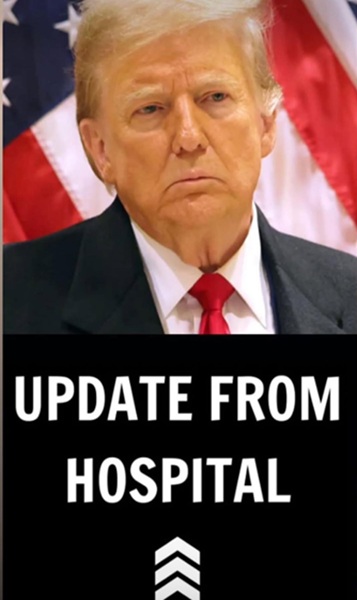
When Donald Trump delivered a roughly twenty-minute public address, most viewers focused on familiar political themes — policy positions, campaign rhetoric, and partisan messaging.
For Dr. Jonathan Reiner, however, the content itself was not the focal point.
As a cardiologist and professor of medicine at George Washington University, Reiner approached the moment through a different lens — one shaped by decades of clinical experience observing how stress, physiology, and human behavior manifest outwardly. His attention was drawn not to what was said, but how it was said.
Reiner later explained that what stood out to him was the pace, intensity, and physical presentation of the speaker. The speech appeared unusually fast, forceful, and pressured. Trump’s voice was elevated, his words flowed rapidly, and the overall cadence felt accelerated beyond what Reiner considered typical — even by Trump’s own standards.
Reiner compared the experience to listening to an audio recording played at double speed. The effect, he suggested, was not merely stylistic but physically striking.

Importantly, Reiner did not claim this observation proved anything definitive. Instead, he framed it as a moment that raised broader questions — questions about stress regulation, endurance, and physical strain — especially when the individual in question is a current or potential holder of the highest executive office in the United States.
Clarifying the Boundary: Observation Is Not Diagnosis
From the outset, Reiner has been careful to draw a clear ethical boundary.
He has never examined Donald Trump, has no access to his private medical records, and has repeatedly emphasized that he cannot and will not diagnose the former president. His remarks, by his own description, represent observational commentary, not clinical judgment.
This distinction matters.
Medical ethics strongly discourage diagnosing individuals from a distance, particularly public figures. Reiner has acknowledged this constraint explicitly, noting that his role is not to label conditions or speculate about hidden illnesses, but to comment on visible, observable behavior — the same behavior available to millions of viewers.
In Reiner’s view, such discussion is not only permissible but reasonable when the individual involved holds, or seeks to hold, extraordinary power.
He has argued that the public has a legitimate interest in noticing patterns of behavior that may reflect stress load, workload management, and physical resilience, provided those discussions remain factual, cautious, and free of sensationalism.
Speech Patterns as Physiological Signals
Human speech is not merely a cognitive function; it is also a physiological one.

Tone, volume, speed, and rhythm are influenced by a range of factors, including adrenaline levels, emotional arousal, fatigue, anxiety, and situational pressure. In clinical settings, physicians often pay close attention to these cues — not as diagnoses, but as signals.
According to Reiner, Trump’s delivery during the speech appeared unusually intense, even by political standards. The rapid pacing and elevated vocal energy created an impression of urgency that felt sustained rather than momentary.
Reiner described the cadence as “pressured,” a neutral clinical term used to describe speech that feels fast and forceful, sometimes associated with heightened physiological arousal.
Crucially, this does not imply illness.
Rapid or forceful speech can arise from many benign causes: excitement, performance strategy, stress, lack of rest, or deliberate rhetorical choice. Political candidates often amplify intensity to energize audiences, particularly during campaigns.
Reiner has acknowledged all of these possibilities.
However, his concern was not tied to a single instance. Rather, he has pointed to what he describes as patterns over time — fluctuations between moments of apparent fatigue and moments of extreme intensity.
Patterns, Not Moments: The Importance of Repetition
One isolated speech proves little. Reiner has emphasized that his observations stem from repeated exposure to Trump’s public appearances across different settings.
At times, Trump has appeared subdued, fatigued, or low-energy during lengthy events. Media outlets over the years have occasionally described him as appearing drowsy during extended meetings or ceremonies.
At other moments, by contrast, Trump has displayed highly energized, rapid, and forceful delivery, sometimes for prolonged periods.

Reiner has described this contrast using general clinical language, including the term “daytime somnolence,” which simply refers to excessive daytime sleepiness.
This term is often misunderstood.
Daytime somnolence does not indicate a specific disease. It can result from many common factors: travel schedules, disrupted sleep, stress, aging, demanding workloads, or irregular routines. Reiner has not suggested otherwise.
His point has been that visible swings in energy and alertness, when observed repeatedly in a high-profile leader, naturally invite discussion — not accusation, but inquiry.
Media Interpretation and Official Responses
Over time, media coverage of Trump’s demeanor has varied widely, often filtered through partisan lenses.
Some outlets have highlighted moments where Trump appeared fatigued or disengaged. Others have emphasized his stamina, schedule, and frequent public appearances as evidence of resilience.
The White House, during Trump’s presidency, consistently dismissed suggestions of fatigue or cognitive decline as misleading or politically motivated. Trump himself has repeatedly rejected such interpretations, describing his energy levels as strong and his performance as deliberate.
Official medical summaries released during his presidency described him as being in good or excellent health, with normal cognitive function. These reports were signed by White House physicians and intended to reassure the public.
Supporters argue that such official assessments should be taken at face value and that external commentary risks blurring the line between observation and speculation.
Reiner has acknowledged this argument, but has also noted that official statements do not always fully resolve public concern, particularly when observable behavior appears inconsistent to some viewers.
Transparency and the Presidency: A Complicated History
The question of presidential health transparency is not new.
Historically, U.S. administrations have often limited public disclosure about a president’s physical or cognitive condition. Franklin D. Roosevelt’s paralysis was carefully concealed. John F. Kennedy’s chronic pain and medical treatments were not fully disclosed during his lifetime.
In more recent decades, debates around age, cognition, and endurance have become more prominent, as political leaders remain active later in life under intense public scrutiny.

Reiner has framed his comments within this historical context. He does not argue for full medical disclosure, nor does he claim that observable behavior overrides official medical evaluations.
Instead, he has suggested that a balance is needed — one that respects privacy while acknowledging the public’s interest in the physical and cognitive readiness of those who govern.
Transparency, in his view, does not require revealing every medical detail, but it does require credibility and consistency.
Stress, Power, and Human Limits
The presidency of the United States is widely regarded as one of the most demanding roles in the world.
The position involves long hours, constant decision-making, international travel, crisis management, and unrelenting public exposure. Medical experts broadly agree that prolonged stress can affect speech patterns, sleep quality, emotional regulation, and physical demeanor — even in otherwise healthy individuals.
Elevated speech, rapid cadence, and forceful delivery can reflect adrenaline, anxiety, or situational pressure. Fatigue can result from travel, disrupted sleep, or sustained workload.
Reiner has emphasized that stress responses are human, not pathological.
His concern is not that such responses exist, but that they are worth acknowledging, especially when they appear repeatedly in leaders whose decisions affect millions.
Style Versus Signal: The Trump Factor
Any discussion of Trump’s presentation must account for his distinctive political style.
Trump has long favored high-energy, unconventional delivery. His supporters often interpret his cadence as passion, confidence, and authenticity rather than instability. His rallies are intentionally intense, designed to energize audiences and dominate attention.
Reiner has acknowledged that political personality and rhetorical strategy play a significant role. He has explicitly stated that style alone cannot be used to infer health status.
However, he maintains that when intensity appears uncontrolled or sharply inconsistent, it becomes reasonable — not irresponsible — for observers to comment cautiously on what they see.
The key, he argues, is restraint: avoiding diagnosis, avoiding certainty, and avoiding political framing.

Toward a Measured Conversation
At its core, Reiner’s commentary is less about Donald Trump as an individual and more about a broader societal challenge.
How should democratic societies assess the capacity of their leaders?
How do we balance privacy with accountability?
How do we discuss visible behavior without turning observation into accusation?
Reiner’s position is that silence is not neutrality. Ignoring observable signs of strain does not serve the public interest any more than sensationalism does.
What he advocates for is measured discussion — grounded in ethics, informed by medical understanding, and free from partisan intent.
One of the most sensitive aspects of Dr. Jonathan Reiner’s public remarks is the ethical line between observation and diagnosis. In modern medicine, this boundary is taken seriously.
The so-called “Goldwater Rule,” established by the American Psychiatric Association, discourages mental health professionals from offering diagnoses of public figures they have not personally examined.
While Reiner is a cardiologist rather than a psychiatrist, he has repeatedly acknowledged the broader ethical principle behind this rule: medical authority carries influence, and that influence must be exercised with restraint.
For this reason, Reiner has been careful to avoid labeling Donald Trump with any condition — physical, cognitive, or psychological. He has not asserted illness, impairment, or incapacity. Instead, he has framed his remarks as contextual observations, emphasizing uncertainty rather than certainty.
This distinction is crucial. Observation describes what is visible; diagnosis claims underlying cause. Reiner has explicitly limited himself to the former.
In interviews and public commentary, he has emphasized that visible changes in speech rhythm, energy level, or alertness do not point to a single explanation. Such changes can reflect stress, sleep disruption, performance style, age, or situational pressure — all common among individuals in demanding roles.
By maintaining this restraint, Reiner has sought to remain within ethical norms while still engaging in a conversation he believes is socially relevant.
Why Observable Behavior Still Matters
Despite ethical limitations, Reiner argues that observable behavior cannot simply be dismissed as irrelevant.
Leadership is not exercised in private. Presidents and presidential candidates operate under constant public scrutiny because their judgment, stamina, and decision-making capacity have real-world consequences. Speech, demeanor, and physical presence are not trivial details; they are part of how leadership is enacted.
Throughout history, voters have assessed leaders not only by policy proposals but also by perceived strength, composure, clarity, and endurance. These assessments are imperfect, subjective, and often biased — but they are also unavoidable.
Reiner has argued that acknowledging observable behavior does not mean drawing conclusions from it. Rather, it means recognizing that public performance is itself a form of information, even if that information is incomplete.
Ignoring visible signs of strain, he suggests, can be as misleading as exaggerating them.
Political Polarization and the Reaction to Reiner’s Remarks
Unsurprisingly, Reiner’s commentary has provoked sharply divided reactions.
Critics have accused him of politicizing medicine and undermining democratic choice by casting doubt — however cautiously — on a political figure’s fitness. Some argue that medical professionals should refrain entirely from commenting on public figures outside formal evaluations.
Supporters, on the other hand, contend that Reiner’s remarks are neither partisan nor irresponsible. They argue that discussing observable behavior is not an attack, but a form of civic engagement — particularly when conducted with restraint and transparency.
This split mirrors broader political polarization in the United States, where even neutral language is often interpreted through ideological lenses. In such an environment, intent is frequently overshadowed by perception.
Reiner has acknowledged this dynamic, noting that any discussion of health in politics is likely to be weaponized, regardless of how carefully it is framed. Nevertheless, he maintains that fear of misinterpretation should not eliminate thoughtful discussion altogether.
Age, Endurance, and Modern Leadership
Underlying this debate is a larger structural reality: political leaders in democratic societies are remaining active later in life than ever before.
Advances in medicine and longevity have extended careers, but they have also intensified questions about endurance, adaptability, and resilience under pressure. These questions are not unique to Donald Trump; they apply broadly across political systems and ideologies.
Medical experts generally agree that aging is highly individual. Chronological age alone does not determine capacity. Some individuals maintain sharp cognition and physical stamina well into advanced age, while others experience earlier decline.
Because of this variability, Reiner has cautioned against simplistic assumptions. His focus has not been on age itself, but on how stress and workload interact with human limits over time.
The presidency, with its relentless demands, amplifies these interactions. Even healthy individuals can show signs of fatigue or intensity under sustained pressure.
Stress, Performance, and the Illusion of Certainty
One of the most important themes in Reiner’s commentary is uncertainty.
In public discourse, there is often a desire for definitive answers: Is a leader fit or unfit? Healthy or unhealthy? Capable or incapable?
Medicine rarely operates in such binaries.
Stress responses can fluctuate daily. Sleep deprivation can temporarily alter speech and demeanor. Adrenaline can heighten energy and intensity. None of these states are permanent, and none automatically indicate pathology.
Reiner has emphasized that visible intensity does not equal instability, just as visible fatigue does not equal incapacity.
His concern is not about labeling, but about acknowledging complexity — resisting the urge to reduce leadership capacity to slogans or absolutes.
Transparency as a Trust-Building Tool
Trust is central to governance. When public trust erodes, even accurate information can be doubted.
Reiner has argued that health transparency, when handled responsibly, can strengthen trust rather than weaken it. Transparency does not mean exposing every medical detail, but it does mean providing credible, consistent information that aligns with observable reality.
Historical examples show that excessive secrecy about leaders’ health can backfire, fueling speculation and undermining confidence. Conversely, thoughtful disclosure can reduce rumor and polarization.
In Trump’s case, official medical summaries emphasized good health and normal cognitive function. Supporters view these assessments as sufficient. Critics remain skeptical, pointing to observable behavior as grounds for further questioning.
Reiner’s position sits between these poles: official assessments matter, but so does public perception. Reconciling the two requires openness, not dismissal.
The Risk of Sensationalism — and the Cost of Silence
Reiner has repeatedly warned against sensationalism. Dramatic headlines, exaggerated claims, and unfounded diagnoses distort public understanding and damage trust in both medicine and journalism.
At the same time, he cautions against silence born of discomfort. Avoiding any discussion of visible strain does not eliminate concern; it merely drives it underground, where rumor and misinformation flourish.
The challenge, he suggests, is to hold space for careful conversation — one that acknowledges uncertainty, respects ethical limits, and resists political exploitation.
Leadership as a Human Condition
Ultimately, Reiner’s commentary returns to a simple but often overlooked truth: leaders are human.
They experience stress, fatigue, adrenaline, and pressure. Their bodies and voices respond to those forces just as anyone else’s would — albeit under far more intense scrutiny.
Recognizing this humanity does not weaken democracy. In many ways, it strengthens it, by grounding expectations in reality rather than myth.
The question is not whether leaders show signs of strain, but how societies respond to those signs — with panic, denial, or thoughtful engagement.
The Broader Democratic Question
Beyond Donald Trump, Reiner’s observations raise a broader democratic issue: how should societies evaluate readiness for leadership in an era of prolonged careers, constant visibility, and extreme polarization?
There is no perfect framework. No test can fully capture judgment, resilience, or clarity under pressure.
What remains essential, however, is a commitment to honest conversation, ethical restraint, and factual grounding.
Democracy does not require certainty — it requires trust, transparency, and the willingness to confront complexity without fear.
Conclusion: Observation Without Judgment
Dr. Jonathan Reiner’s observations have generated debate not because they provide answers, but because they illuminate tensions that modern democracies have yet to resolve.
His commentary does not claim illness. It does not assert incapacity. It does not offer diagnosis.
Instead, it highlights the space between what is officially stated and what is publicly observed — a space that invites discussion rather than conclusion.
Whether one agrees with Reiner or not, his approach underscores an enduring reality: the health and capacity of those in power matter, and discussing them responsibly is neither unethical nor partisan.
In an era defined by polarization and spectacle, maintaining a measured, factual, and ethical approach to such discussions may be one of the most difficult — and most necessary — tasks of all.
