For months, I had been watching my son slowly lose the things that once made him a happy, energetic child. His laughter had become rare.
His favorite activities had been replaced by hospital appointments, medical procedures, and long days when even getting out of bed seemed exhausting.
At twelve years old, Evan should have been worrying about school, video games, baseball, and what he wanted to do during summer vacation.
Instead, he was learning the language of hospitals.
He knew the difference between different medical appointments. He recognized the sounds of certain machines. He understood that some days would be harder than others.
And as his mother, I had learned to smile even when I was terrified.
I was Melissa. I was thirty-three years old, and for most of Evan’s life, it had been just the two of us.
I had become accustomed to carrying responsibilities that were never supposed to belong to one person.
But nothing had prepared me for watching my child battle cancer.
Then, one afternoon, something unexpected happened.
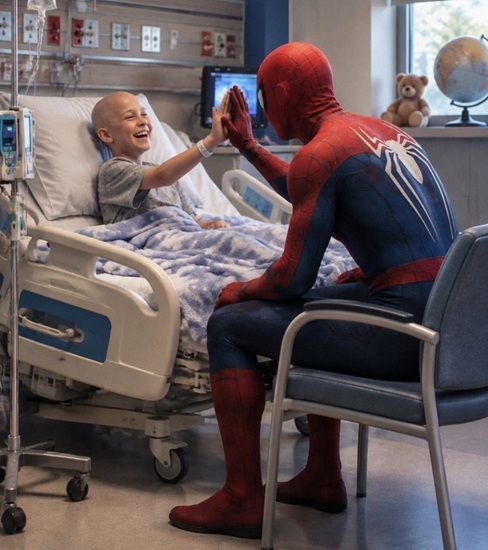
A man dressed as Spider-Man entered my son’s hospital room.
At first, I thought it was part of a volunteer visit.
The costume was convincing enough, and the man immediately began entertaining Evan with jokes, playful movements, and exaggerated superhero gestures.
For the first time in months, I heard my son laugh without forcing himself.
It wasn’t a polite smile or a brief reaction to something funny.
It was the kind of laughter I remembered from before the diagnosis.
Evan sat up a little straighter. He asked questions, made jokes, and even challenged Spider-Man to explain how he could possibly defeat Doctor Octopus.
I stood quietly near the doorway, watching.
For a little while, the hospital room didn’t feel like a hospital room.
It felt like my son’s childhood had briefly returned.
I wanted to thank the stranger.
I wanted to tell him that his visit had meant more than he could possibly understand.
But when the visit ended, something about his behavior caught my attention.
He seemed unusually eager to leave.
He avoided looking directly at me. He kept his head lowered, and when I thanked him, he barely responded.
Then he walked away.
Something inside me told me that I shouldn’t simply let him disappear.
I followed him.
When I caught up with him, I reached toward the mask.
“Wait. I want to thank you properly.”
He hesitated.
Then I pulled it off.
And forgot how to breathe.
The man standing in front of me had more gray in his hair than I remembered.
His face was thinner. He looked older, tired, and somehow unfamiliar.
But I knew those eyes.
I knew that face.
“Troy?”
He immediately looked down.
My knees weakened.
I reached for the doorframe, but my legs gave way before I could properly steady myself. I ended up sitting on the stone step, staring at the man I hadn’t seen in twelve years.
For twelve years, I had imagined what I would say if I ever encountered my son’s father again.
Sometimes I imagined screaming at him.