
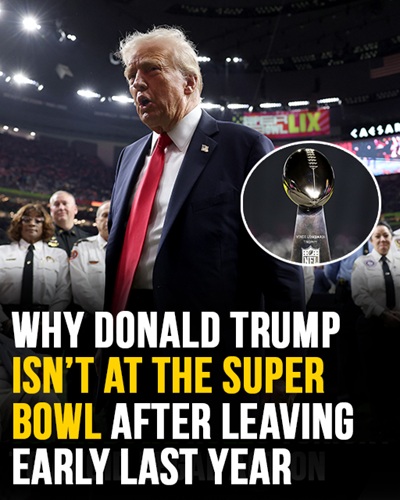
Tens of thousands of fans have descended upon Levi’s Stadium in Santa Clara, California, as Super Bowl LX unfolds as one of the most anticipated sporting events in the United States and across the globe.
Each year, the Super Bowl transcends the boundaries of professional football, evolving into a cultural phenomenon that blends athletics, entertainment, advertising, and national identity into a single, globally broadcast spectacle.
Beyond the game itself, the Super Bowl functions as a mirror of American society, reflecting shifting cultural values, political discourse, and public sentiment.
For this reason, the presence—or absence—of prominent political figures often draws nearly as much attention as the contest on the field.

This year, one notable absence has generated widespread discussion: former President Donald J. Trump is not in attendance at Super Bowl LX.
A Historic Precedent and Heightened Expectations
Trump’s absence is particularly noteworthy because of the historical precedent he set just one year earlier. In 2024, he became the first sitting U.S. president to attend a Super Bowl in person, a milestone moment that drew extensive media coverage and commentary.
That appearance marked a significant departure from long-standing presidential tradition, as previous presidents had largely limited their Super Bowl involvement to pre-recorded interviews or ceremonial coin toss messages.
His attendance was widely interpreted as both a cultural gesture and a political signal—an acknowledgment of the Super Bowl’s unmatched reach and influence in American life. As a result, many observers expected that Trump’s engagement with the event might continue in future years, making his absence from Super Bowl LX a subject of renewed curiosity.
Trump’s Stated Reason: Distance and Logistics
In the lead-up to Super Bowl LX, Trump addressed his decision not to attend, citing the practical challenges associated with travel. He explained that the event’s location on the West Coast played a significant role, describing the journey as simply “too far away.”
The distance between Washington, D.C., and Santa Clara, California, spans approximately 2,700 miles, requiring a flight time of five to six hours under optimal conditions.
For a former president, such travel extends far beyond ordinary logistics. It involves advance security teams, coordination with federal and local law enforcement, secure transportation routes, and contingency planning for large public appearances.

Even after leaving office, former presidents continue to receive extensive protection from the U.S. Secret Service, making spontaneous or discretionary travel significantly more complex than it is for private citizens.
From a logistical standpoint alone, the explanation carries weight.
Security, Time, and Presidential Protocol
High-profile events like the Super Bowl require extraordinary planning when attended by current or former heads of state. Entire sections of stadiums may need to be secured, spectators vetted, and emergency response plans expanded. The presence of a former president also increases media scrutiny and logistical strain on event organizers.
In addition to security concerns, time commitment remains a crucial factor. Travel to and from California, combined with preparatory briefings, public appearances, and post-event obligations, can consume several days.
For a political figure actively engaged in campaigning, public speaking, or legal matters, such an investment of time is not insignificant.
Trump’s explanation, therefore, aligns with the realities faced by high-profile individuals, particularly those whose schedules are tightly structured and continuously evolving.
Speculation Beyond Logistics
While distance and security concerns provide a reasonable explanation, political analysts and media commentators have suggested that logistical challenges may not fully account for Trump’s decision. Historically, presidential attendance at major cultural events has often carried symbolic significance, serving as a gesture of unity or public engagement.
As a result, Trump’s absence has been interpreted by some observers as part of a broader pattern reflecting the increasingly complex relationship between politics and mass entertainment.

In recent years, the Super Bowl has evolved into a platform where cultural identity, social values, and artistic expression intersect. Halftime performances, in particular, are frequently analyzed not only for their entertainment value but also for their cultural messaging and representation.
This evolution has led to ongoing public debate about whether the Super Bowl should remain politically neutral or embrace its role as a global cultural stage.
The Super Bowl as a Cultural Institution
The modern Super Bowl is no longer simply a championship football game. It is a multi-layered event that shapes conversations far beyond sports. Advertising campaigns debut during its broadcasts, artists reach unprecedented audiences, and social themes often emerge through performances and messaging.
Because of this, political figures are often placed in a delicate position. Attendance can be interpreted as endorsement, while absence may be viewed as disengagement or silent protest—even when none is intended.
Trump’s decision not to attend Super Bowl LX exists within this broader cultural framework, where every choice made by a prominent public figure is subject to interpretation.
Media and Public Reaction
News outlets, commentators, and social media users were quick to note Trump’s absence. Discussions ranged from practical explanations to broader cultural interpretations. Some emphasized the logistical realities of cross-country travel, while others framed the decision as a reflection of Trump’s evolving relationship with mainstream cultural institutions.
Supporters largely echoed the logistical explanation, emphasizing efficiency, scheduling priorities, and security considerations. Critics, meanwhile, suggested that the absence highlights growing divisions over how national events are shaped and represented.
What is clear is that Trump’s decision has once again demonstrated the extent to which the Super Bowl functions as a symbolic arena—not only for sports but for national identity and public discourse.

Looking Ahead
As Super Bowl LX continues to captivate audiences, Trump’s absence serves as a reminder that participation in such events is never purely ceremonial. It reflects a combination of personal choice, logistical reality, and cultural context.
Whether future political leaders will follow Trump’s precedent of in-person attendance—or retreat once again to symbolic gestures—remains an open question.
What is certain is that the Super Bowl will continue to occupy a unique space where sports, culture, and politics converge on a global scale.
As Super Bowl LX unfolds at Levi’s Stadium, the conversation surrounding the event extends far beyond the scoreboard. In the modern era, the Super Bowl has become one of the most influential cultural platforms in the world—an annual moment when sports, entertainment, commerce, and public discourse intersect on an unprecedented scale.
While the absence of a former president has captured headlines, the broader significance of the event lies in how it reflects changing cultural priorities and the evolving role of mass entertainment in shaping public narratives.
The Super Bowl as a Global Cultural Stage
With an audience that regularly exceeds 100 million viewers in the United States alone and millions more watching internationally, the Super Bowl is no longer a strictly American event. It is a global broadcast that showcases not only professional football but also the cultural identity of the nation hosting it.
From halftime performances to pregame ceremonies, every element of the broadcast is carefully curated to appeal to diverse demographics. Music, visual storytelling, and symbolism play an essential role in shaping how the event is perceived worldwide.
As a result, artistic choices made by organizers often carry cultural weight, whether intentionally or not.
Music, Identity, and Representation
Over the past decade, Super Bowl halftime shows and opening performances have increasingly highlighted a wide range of musical genres and cultural influences. Pop, hip-hop, rock, R&B, and Latin music have all taken center stage, reflecting the diversity of contemporary audiences.
This shift mirrors broader trends within the entertainment industry, where global streaming platforms and social media have reshaped how music is consumed and shared. Artists today often represent not just individual success but entire cultural movements, communities, and generational identities.
Because of this, performances are frequently interpreted through social and political lenses, even when the primary intention is celebration and entertainment.

Why Performances Spark Debate
The Super Bowl’s immense visibility ensures that every artistic choice is scrutinized. Supporters may view diverse performances as a sign of inclusivity and cultural progress, while critics may perceive them as departures from tradition or as overly symbolic.
This tension is not new. Throughout the event’s history, halftime shows have sparked debate over musical style, lyrical themes, stage design, and overall tone. What has changed is the speed and intensity with which these debates unfold, amplified by social media and 24-hour news cycles.
In this environment, even neutrality can be interpreted as a stance.
Political Figures and Cultural Events
For politicians, engagement with major cultural events presents both opportunity and risk. Attendance can signal relatability, unity, and public engagement, while absence may be interpreted as disinterest or disagreement—even when motivated by practical considerations.
Historically, presidents and former presidents have approached such events cautiously. Many have opted for symbolic participation, such as recorded messages or ceremonial appearances, rather than full attendance.
Trump’s prior attendance at a Super Bowl broke with tradition, raising expectations and reshaping how his future engagement would be evaluated. His absence from Super Bowl LX therefore exists within a new framework of heightened scrutiny.
Public Interpretation and Media Narratives
Media coverage of Trump’s absence illustrates how narratives are constructed in real time. News outlets, commentators, and social media users each frame the decision through different lenses:
Practical lens: emphasizing travel distance, security, and scheduling realities
Cultural lens: focusing on evolving entertainment norms and artistic expression
Political lens: interpreting the decision as symbolic within a broader ideological context
None of these perspectives exist in isolation. Together, they form a layered public conversation that reflects the complexity of modern media consumption.
The Commercial Dimension
Beyond culture and politics, the Super Bowl is also a commercial powerhouse. Advertising slots during the broadcast cost millions of dollars, and brands carefully craft messages designed to resonate emotionally with viewers.
Advertisers increasingly align themselves with themes such as unity, diversity, resilience, and shared experience—values that mirror the broader cultural narratives surrounding the event.
This commercial dimension further reinforces the Super Bowl’s role as a reflection of societal priorities, not merely a sporting contest.
Audience Expectations in a Changing Era
Modern audiences expect more from major events than competition alone. Viewers anticipate storytelling, spectacle, and emotional resonance. This expectation places pressure on organizers to innovate while still honoring tradition.
As generational demographics shift, so do definitions of what feels “representative” or “authentic.” Younger viewers, in particular, tend to value inclusivity and cultural variety, while older audiences may prioritize familiarity and continuity.
Balancing these expectations is an ongoing challenge—and one that inevitably shapes public reactions.
The Broader Implications for Future Super Bowls
Trump’s absence from Super Bowl LX may influence how future political figures approach similar events. It underscores the reality that participation is no longer a neutral act; it is interpreted within a complex web of cultural, political, and media-driven narratives.
Future leaders may weigh the symbolic impact of attendance more carefully, choosing engagement strategies that align with both personal priorities and public perception.
At the same time, the Super Bowl will likely continue evolving as a platform for cultural expression, reflecting the values and conversations of the moment.
A Reflection on Visibility and Choice
Ultimately, the story of Super Bowl LX is not defined by who attended or who did not. It is defined by how visibility, choice, and interpretation intersect in the modern public sphere.
Trump’s decision to skip the event highlights the reality that absence can be as meaningful as presence—particularly when the platform involved carries immense cultural significance.
The Super Bowl remains a shared national moment, one that invites celebration, debate, and reflection. Its power lies not only in the game itself but in its ability to bring diverse perspectives into a single conversation.
Conclusion: More Than a Game
Super Bowl LX reinforces the idea that major sporting events are no longer confined to athletics. They are cultural landmarks that reflect who we are, what we value, and how we communicate as a society.
Trump’s absence adds another layer to this ongoing narrative, illustrating how personal decisions by public figures can resonate far beyond their immediate context.
As fans cheer, advertisers compete for attention, and artists perform on one of the world’s biggest stages, the Super Bowl continues to demonstrate its unique role at the crossroads of sports, culture, and public life.
In the years ahead, the conversations sparked by events like Super Bowl LX will likely grow even more complex—serving as a reminder that in today’s interconnected world, no major cultural moment exists in isolation.
