
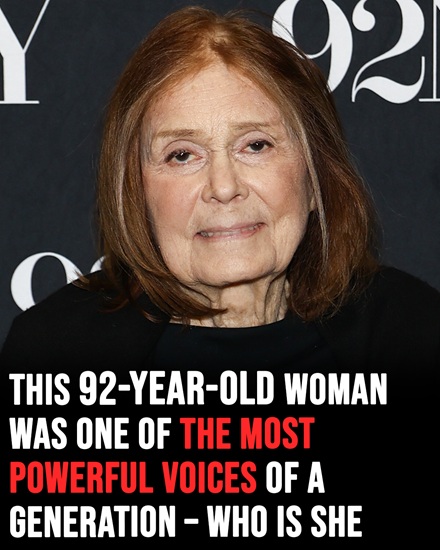
Gloria Marie Steinem, born on March 25, 1934, in Toledo, Ohio, has spent more than six decades as a pioneering journalist, activist, and organizer, shaping the modern feminist movement and influencing generations of women worldwide.
Her life story intertwines personal resilience with groundbreaking social advocacy, reflecting a commitment to equality that has endured for decades.
Steinem’s early years were shaped by family instability following her parents’ divorce. She spent much of her childhood caring for her mother, Ruth, who struggled with chronic depression, while navigating inconsistent schooling and frequent relocations.
These formative experiences exposed Steinem to the realities of social inequality and personal responsibility from an early age.

Her father, Leo Steinem, worked as a traveling salesman, moving the family to different cities, while her mother eventually returned to settle in Toledo.
Witnessing these challenges firsthand gave Steinem a deep understanding of societal pressures and a sensitivity to marginalized voices, shaping the perspective that would guide her work as an activist.
From a young age, Steinem displayed intellectual curiosity and a love for reading and writing. She often immersed herself in books, penned her own stories, and cultivated a desire to understand the world beyond her immediate environment.
This early engagement with ideas and communication laid the groundwork for her future career as a journalist and thought leader.
After graduating high school, Steinem attended Smith College in Massachusetts, one of the nation’s most prestigious women’s liberal arts institutions.
Majoring in government, she graduated magna cum laude in 1956, demonstrating not only academic excellence but also a growing interest in political systems, social structures, and the dynamics of power in society.
Following college, Steinem received a Chester Bowles Fellowship, which enabled her to spend two years in India studying grassroots activism, community organizing, and nonviolent resistance.

Her experiences abroad, reporting for Indian publications and observing local movements firsthand, profoundly influenced her understanding of collective action and social change, providing a global perspective she carried into her work in the United States.
Upon returning to America in 1960, Steinem began working as a freelance journalist in New York City, quickly earning a reputation for incisive reporting, cultural commentary, and a keen understanding of social issues.
Her writing often challenged established norms and amplified the voices of those frequently overlooked in mainstream media.
A breakthrough moment in Steinem’s career came in 1963 with her undercover exposé, “I Was a Playboy Bunny,” which exposed the sexism and exploitation faced by women employed at Playboy Clubs.
The piece received national attention for its boldness, shedding light on systemic inequalities and positioning Steinem as a fearless voice in the fight for gender equity.
By the late 1960s, Steinem’s writing had become increasingly political. She authored the column “The City Politic” for New York magazine, examining social movements and engaging with growing discussions around civil rights, gender equality, and participatory democracy.
Her work during this period emphasized the interconnectedness of culture, policy, and activism.
In 1971, Steinem collaborated with prominent figures such as Betty Friedan, Shirley Chisholm, and Bella Abzug to establish the National Women’s Political Caucus. This organization aimed to support women in pursuing elected and appointed roles in government, ensuring that women’s voices were represented in political decision-making.

That same year, Steinem co-founded Ms. magazine, initially as a section within New York magazine before it became a standalone publication.
Ms. offered an unprecedented platform for feminist perspectives, directly addressing issues such as workplace inequality, reproductive rights, sexual harassment, and domestic violence — topics rarely given serious attention in mainstream media at the time.
Throughout the 1970s and 1980s, Steinem traveled extensively, speaking at colleges, rallies, and conferences across the United States.
She became the public face of the women’s liberation movement, inspiring grassroots activism while navigating both acclaim and criticism amid national debates about gender roles and social reform.
Steinem also helped establish organizations such as the Women’s Action Alliance and the Ms. Foundation for Women, creating resources and networks that empowered activists, amplified women’s voices, and promoted structural changes in society.
These initiatives strengthened the feminist movement by combining advocacy with practical support for women pursuing careers, education, and political engagement.
In the 1990s, Steinem played a key role in launching Take Our Daughters to Work Day, a national program encouraging girls to explore professional opportunities and envision diverse career paths. Her work in this initiative reinforced the importance of early empowerment, mentorship, and breaking down gendered societal expectations.

Steinem extended her influence into media advocacy as well, co-founding the Women’s Media Center alongside Jane Fonda and Robin Morgan. This organization emphasized the critical role of women in shaping media narratives and promoted female leadership in journalism, television, and film, highlighting the ongoing struggle for representation and equality in the public sphere.
She authored numerous influential books and essays, including Outrageous Acts and Everyday Rebellions, Revolution from Within, and Moving Beyond Words, which explored themes of feminism, identity, and social justice.
Her 2015 memoir, My Life on the Road, recounted her experiences traveling, organizing, and advocating for change, offering personal insights into decades of activism.
At 92, Steinem continues to write and speak publicly, recently announcing a new memoir, An Unexpected Life, which combines personal reflection with observations on contemporary social movements.
Her ongoing engagement demonstrates a commitment to mentoring younger generations and ensuring that the struggle for equality remains visible and actionable.
Steinem’s lifetime contributions were formally recognized in 2013 when she received the Presidential Medal of Freedom, the highest civilian honor in the United States, highlighting her transformative impact on American society and global feminist thought.
While Steinem never had biological children, she married entrepreneur David Bale in 2000; he passed away three years later. She has spoken openly about the ways personal choices intersect with societal expectations, advocating for women to define their lives on their own terms while challenging restrictive norms.
Her legacy is extensive, reshaping public discourse around gender, empowering women to seek leadership roles, and inspiring countless individuals to engage in civic life.
By merging personal experience with broader activism, Steinem has cultivated a lasting platform that continues to influence cultural, political, and legal norms.
Even in her later years, Steinem remains a powerful symbol of advocacy, resilience, and unwavering commitment to social justice.
Her work demonstrates that meaningful change is both long-term and collaborative, requiring persistent effort, community engagement, and strategic action.
Gloria Steinem’s life illustrates how one individual, dedicated to principle and action, can contribute to lasting societal transformation.
Through decades of organizing, writing, and speaking, she has shaped the feminist movement and inspired generations to fight for equity, justice, and human rights.
Today, Steinem’s influence continues to guide activists, educators, and policymakers, ensuring that the lessons of her career endure and that the principles of equality remain central to social progress around the world.
Her story is a testament to the power of vision, persistence, and courage in advancing human rights and social change.
