“Sarah, I need to apologize before I thank you.” I read the sentence once. Then I read it again.
For several seconds, I simply sat at my kitchen table, holding the letter with both hands, unable to understand why those words had been chosen as the opening of a goodbye.
The envelope was thick and white. My name was written across the front in familiar, uneven handwriting. I recognized it immediately. I’d seen those letters on hospice forms, handwritten notes, and the occasional grocery list Larry had made when I insisted on bringing him things he didn’t need.
The postmark was dated the day before he died.
The letter had arrived six days after his funeral.
At first, I’d smiled when I saw it. I imagined Larry sitting somewhere in his hospice room, carefully writing down the things he wanted me to remember. He had always been particular about saying thank you. Even when I brought him something as ordinary as a paper cup of coffee, he thanked me as though I’d given him something extraordinary.
I expected a goodbye.
I expected a few memories.
Perhaps a joke about my terrible habit of buying too many things.
Instead, the next sentence made my stomach tighten.
“Nobody was going to bury me as a John Doe.”
I lowered the paper.
For a moment, the kitchen seemed unusually quiet.
I looked toward the empty chair across from me, almost expecting Larry to be sitting there with his black coffee, making one of his dry observations about how seriously I took everything.
But the chair was empty.
Larry was dead.
And suddenly, I wasn’t sure I had ever understood the man I’d married.
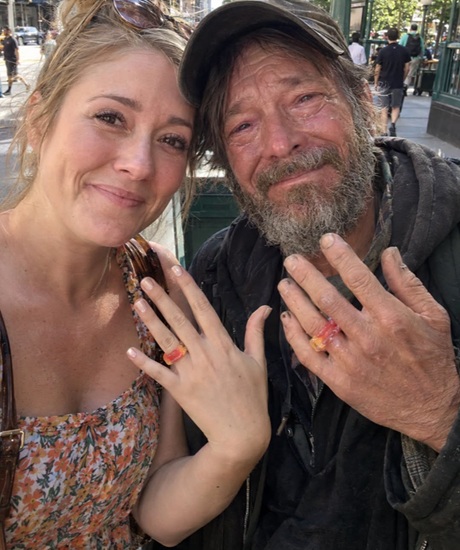
Less than a month earlier, Larry had been sitting outside my subway station with a piece of cardboard resting across his knees.
The message written on it was short.
MARRY ME. I HAVE ONE MONTH LEFT TO LIVE.
I had known Larry for two years.
Every weekday morning, I passed the same entrance on my way to work. There was a small coffee kiosk beside the station, and I had developed a routine that rarely changed.
One coffee with cream for myself.
One black coffee for Larry.
He was usually sitting near the station entrance, wrapped in an old coat, watching commuters hurry past him.
Some people avoided looking in his direction. Others dropped a few coins into his cup without stopping. A few greeted him.
I usually stayed for five minutes.
Sometimes we discussed the weather. Sometimes he complained about the pigeons that gathered near the entrance. On particularly cold mornings, he criticized my shoes.
“Those things look like they were designed by someone who hated feet,” he once told me.
I had laughed so hard that I nearly spilled my coffee.
Larry had a way of making ordinary mornings feel less ordinary.
He never demanded anything from me.
He never made me feel guilty for being busy.