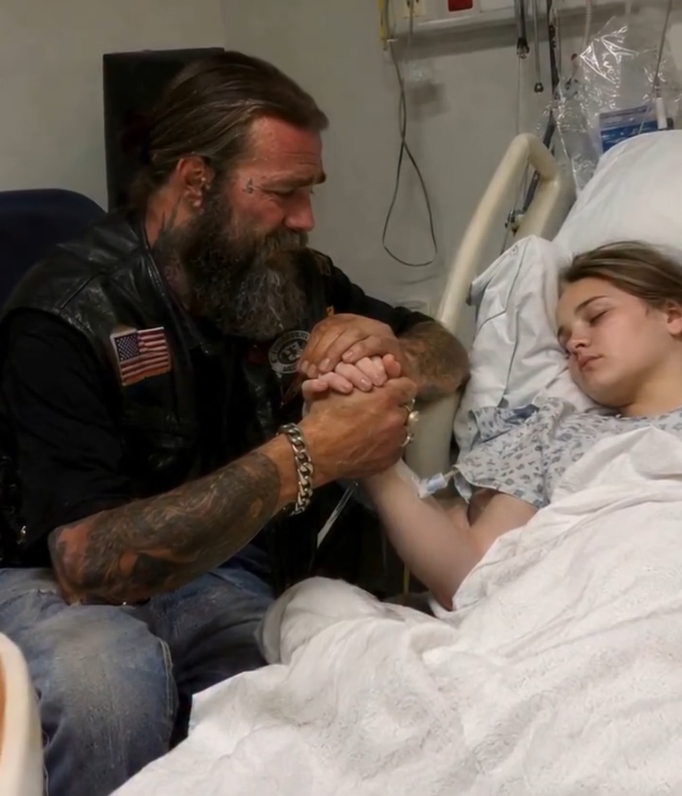
For six months, a large man with a gray beard walked into my seventeen-year-old daughter’s hospital room at exactly three o’clock every afternoon. He wore a leather vest, heavy boots, and an expression that made him look like someone who had lived through more pain than he ever wanted to talk about.
He never stayed longer than an hour.
He never asked for anything.
He simply walked to my daughter’s bedside, took her hand, spoke softly to her, and sometimes read from a fantasy book until four o’clock. Then he put her hand gently back on the blanket, nodded to me, and walked away.
For months, I had no idea who he was.
And I never imagined that when I finally learned his name, I would discover that he was the very person responsible for putting my daughter in that hospital bed.
My name is Sarah. I’m forty-two years old, and my daughter Hannah was seventeen when our lives changed in a way I still struggle to describe.
Six months earlier, Hannah had been coming home from her part-time job at a bookstore. She was young, independent, and excited about the little things teenagers look forward to. She had her own plans, her own friendships, and a future she was slowly beginning to imagine.
That evening, she was driving home when a drunk driver ran a red light and struck the driver’s side of her car.
The accident happened only five minutes from our home.
Five minutes.
That was all the distance between an ordinary evening and the nightmare that followed.
When I received the call, I remember how difficult it was to understand what the person on the other end was saying. I kept asking the same questions, as if repeating them could somehow change the answers.
Where was Hannah?
Was she conscious?
Could I talk to her?
I was told she had been taken to the hospital.
I don’t remember much about the drive there. I remember my hands shaking. I remember looking at traffic lights and feeling angry that the world was still moving normally while my daughter’s life was hanging in the balance.
When I finally reached the hospital, everything seemed too bright.
Doctors and nurses moved quickly. Conversations happened around me, but I could barely process a word. I kept searching faces for someone who could tell me that Hannah would be okay.
Instead, I was taken to a room where machines surrounded my daughter.
She was lying still.
Her eyes were closed.
The girl who had been laughing in our kitchen that morning was suddenly unable to tell me whether she was scared, whether she was hurting, or whether she could hear me at all.
Hannah was in a coma.
I remember reaching for her hand and whispering her name over and over.
“Hannah, sweetheart. Mom’s here.”
I told her she was safe.
I told her I loved her.
I told her she needed to come back to us.
But there was no answer.
The doctors explained what they could, and I tried to remember every word. I asked questions, received answers, and then asked the same questions again because fear made it difficult to hold anything in my mind for long.
Eventually, I began living in room 223.
My world became that hospital room, the hallway outside it, and the waiting area where families tried to sleep in uncomfortable chairs.
I learned which vending machines were most likely to have something decent to eat. I learned which nurses worked certain shifts. I learned how to fold a blanket around myself while sitting upright, and how to wake up with a stiff neck and immediately look toward Hannah’s bed.
Jenna was one of the nurses I came to trust.
She was patient, kind, and never made me feel foolish when I asked another question. She knew how exhausted I was, and sometimes she would bring me an extra blanket before I even asked.
I stopped thinking about days in the ordinary sense.
There were no weekends.
No holidays.
No normal mornings or evenings.
There was simply the time before the next doctor came in, the time before the next test, and the time I spent staring at my daughter, hoping to see something change.
And then there was three o’clock.
At first, I didn’t notice the pattern.
I was too overwhelmed by everything happening around Hannah to pay much attention to a stranger coming and going. I thought he might be connected to the hospital somehow.
Then I began recognizing him.
Every afternoon, just before three, the same man appeared at the door.
He was enormous compared with most people in the hallway. His gray beard was thick, his arms covered in tattoos, and his leather vest made him look like someone I would never have expected to see sitting quietly beside a teenager in a hospital bed.
He always knocked lightly.
He always nodded at me.
And he always said the same thing.
“Hey, Hannah. It’s Mike.”
His voice was deep, but gentle.
He never rushed toward her.
He never acted as though he had the right to be there.
He walked to the chair beside her bed, sat down, and carefully took her hand.
Sometimes he brought a fantasy book.
I noticed that because Hannah had always loved stories involving dragons, magical worlds, and characters who had to overcome impossible challenges. The books were familiar in a way that made me feel as though he had somehow found a piece of her personality I hadn’t realized he knew.
He would open the book and begin reading.
His voice filled the room quietly.
Every now and then, he stopped to comment on a character or make a small joke. Sometimes he spoke directly to Hannah as though she were sitting beside him, listening and rolling her eyes at something he had said.
Other afternoons, he didn’t read at all.
He simply held her hand and talked.
“Today wasn’t great, kiddo,” I heard him say once. “But I made it through without drinking. That’s something.”
I looked up from my chair.
He didn’t appear to be talking to me.
He was talking to Hannah.
And then he would continue, telling her about his day, about something that had happened at a meeting, or about how he was trying to do better with his life.
I couldn’t understand it.
Who was he?
Why did he care so much about my daughter?
And why did he come every single day?
At first, I let it happen.
When your child is lying unconscious in a hospital bed, you become strangely protective of every small kindness. You don’t want to question someone who appears to be bringing comfort.
I thought perhaps Hannah had met him through her job.
Maybe he was a customer at the bookstore.
Maybe he knew one of her friends.
Maybe he was connected to someone in our family and I simply hadn’t heard about him.
But none of those possibilities made sense for long.
Hannah’s friends, Maddie and Emma, didn’t recognize the name Mike.
Her father, Jason, didn’t know him either.
Nobody I asked could explain why a gray-bearded biker was spending an hour every afternoon holding my daughter’s hand.
Meanwhile, the nurses seemed perfectly comfortable with him.
Jenna greeted him like an old friend.
“Hey, Mike. Coffee?”
“Sure, thanks.”
He would smile, take the coffee, and walk into Hannah’s room.
The routine became so familiar that it almost felt as though everyone else knew something I didn’t.
And that made it worse.
I was Hannah’s mother.
I was the one who sat through the doctors’ conversations, signed the paperwork, and spent every night beside her.
Yet a stranger could walk in at three o’clock, hold my daughter’s hand, and seem to belong.
One afternoon, I finally asked Jenna.
“Who is that man?”
She looked toward the hallway.
“Mike?”
“Yes. Mike. Who is he?”
Jenna hesitated just long enough for me to notice.
“He’s a regular,” she said carefully. “Someone who cares about Hannah.”
“That doesn’t tell me anything.”
She looked uncomfortable.
“I don’t think he wants to bother you.”
I stared at her.
“He’s already bothering me. He’s in my daughter’s room every day.”
Jenna didn’t argue.
She simply said that Mike had been respectful, that he never caused trouble, and that he always followed the hospital’s instructions.
It wasn’t an answer.
And by then, I was no longer willing to pretend that I didn’t need one.
For months, I had watched him come and go.
For months, I had wondered what connection he had to Hannah.
And for months, I had told myself that I would eventually ask him.
That afternoon, I finally did.
At four o’clock, Mike closed the book, gently placed Hannah’s hand back on the blanket, and stood.
He nodded at me as usual.
I stood up before he reached the door.
“Excuse me. Mike?”
He turned.
“Yeah?”
I walked toward him.
“I’m Hannah’s mother.”
He nodded once.
“I know. You’re Sarah.”
That caught me completely off guard.
“You know my name?”
“Jenna told me.”
He looked toward the waiting area.
“Would you like to sit for a minute?”
I didn’t want to sit.
I wanted answers.
But I followed him to two plastic chairs in the hallway because I didn’t want to start shouting beside my daughter’s bed.
We sat down.
I looked directly at him.
“I’ve watched you come here every day for months. You sit with my daughter. You hold her hand. You read to her. You talk to her like you know her. And I don’t know who you are.”
My voice was shaking.
“Why are you here?”
Mike rubbed his beard.
For the first time, I noticed how tired he looked.
Not just physically tired.
His eyes carried something that made me uncomfortable, though I couldn’t yet understand why.
He took a breath.
“My name is Mike,” he said. “I’m fifty-eight. I’ve got a wife. Her name is Denise. And I’ve got a granddaughter. Lily.”
I waited.
He looked at his hands.
Then he said something I wasn’t prepared to hear.
“I’m the man who hit your daughter.”
For a moment, I thought I had misunderstood him.
“What?”
He didn’t look away.
“I was driving the truck that hit Hannah.”
The hallway seemed to disappear around me.
I could hear the words, but they didn’t make sense together. This man had been sitting beside my daughter every day. This man had been reading to her. This man had been holding her hand.
And now he was telling me he was the driver.
The drunk driver.
The one who had run the red light.
The one whose actions had brought my daughter into room 223.
“It was my truck,” he said quietly. “I ran the red light. I hit her car.”
I stood up.
My entire body felt hot.
“You’ve got to be kidding me.”
He didn’t move.
“You did this to her?”
I pointed toward Hannah’s room.
“She’s lying in there because of you. And you’ve been coming here every day?”
My voice grew louder, and I didn’t care.
“How could you walk into this room? How could you sit beside her like that?”
Mike lowered his head.
“I know.”
“No, you don’t know!”
I could barely breathe.
For months, I had imagined the person responsible for the crash. I had pictured a stranger who had never thought about Hannah again, someone who had continued living as though the accident had been just another inconvenience.
I had never imagined that the same man would be sitting beside her, reading fantasy books, telling her about his day, and leaving at exactly four o’clock.
I wanted to call security.
I wanted to tell him to get out.
I wanted to ask why he thought he had the right to be near her.
But he didn’t try to defend himself.
He didn’t tell me to calm down.
He didn’t blame the circumstances.
He simply sat there and accepted everything I said.
“I pled guilty,” he told me. “The court gave me ninety days in jail. I lost my license. I went through court-ordered rehabilitation. I’ve been going to AA.”
I stared at him.
“And that makes this better?”
“No,” he said. “It doesn’t.”
He spread his hands, looking toward the room.
“But she’s still in that bed. None of it fixes that.”
That sentence made me angrier because he was right.
Nothing could undo the crash.
Nothing could give Hannah back the months she had lost.
Nothing could erase the fear I felt every time a doctor entered the room with a serious expression.
I told him I should have him banned from the hospital.
I told him I should have called security the first day I saw him.
I told him he had no right to be there.
Mike nodded.
“You can. You’d be right to.”
He didn’t fight me.
He didn’t make excuses.
He just looked like someone who had been waiting for me to say those words.
Then he explained how he had first come to the hospital.
It had been after he completed his sentence.
He said he needed to see Hannah, not because he expected anything from her, but because he could no longer bear thinking about her as just a name in an accident report.
The first time, he hadn’t even been allowed into her room.
Dr. Patel told him it wasn’t appropriate.
So Mike sat in the lobby.
Then he came back the next day.
And the day after that.
He didn’t try to force his way in.
He didn’t argue with the hospital staff.
He simply kept returning, hoping someone would eventually allow him to sit quietly with Hannah.
Eventually, Jenna told him that I was away meeting with the social worker.
She warned him that I probably wouldn’t want him near my daughter if I knew who he was.
He admitted she was right.
I felt my hands trembling.
“You could have stayed away,” I told him.
He closed his eyes.
“I tried.”
He said his sponsor had told him that making amends meant facing the consequences of what he had done, rather than hiding from them.
But I wasn’t ready to hear about making amends.
I wasn’t ready to hear about his recovery.
I wasn’t ready to hear about his meetings or how difficult his life had become after the crash.
I was thinking about Hannah.
Then he told me something else.
His son had died when he was twelve years old.
A bicycle accident.
He said it had been nobody’s fault, but that he knew what it felt like to lose a child and live with an emptiness that never really disappeared.
I flinched.
“Then you should know what you’ve done to us.”
He nodded.
“I do.”
I didn’t want his pain to become a reason for me to feel sorry for him.
I didn’t want to compare our lives.
His loss didn’t erase what happened to Hannah.
And I wasn’t ready to offer him anything.
“I don’t want you near her,” I said finally.
“Not right now.”
Mike nodded.
“Okay.”
He stood slowly.
“If you ever change your mind, I’m at the noon meeting on Oak Street. Every day.”
Then he walked away.
I returned to room 223.
Hannah was still lying in the same position.
The machines continued making their familiar sounds.
I sat beside her and looked at her face.
For months, I had been trying to understand why Mike came.
Now I knew.
And somehow, knowing made everything more complicated.
I thought I would feel relieved when he stopped coming.
I thought I would feel safer.
I thought the room would feel like it belonged to us again.
But the next afternoon, at three o’clock, the door stayed closed.
No leather vest.
No gray beard.
No deep voice reading about dragons.
And I didn’t feel better.
I kept looking at the clock.
At three-thirty, I glanced toward the door.
At four, I realized I had been waiting for him.
I hated that.
I hated the confusion.
I hated that I had become aware of his absence after spending months resenting his presence.
A few days later, Jenna asked me quietly.
“You told him not to come, didn’t you?”
“Yes.”
She nodded.
“I can’t tell you what to do, Sarah. But I’ve never seen someone show up like he did.”
I didn’t answer.
That night, I sat beside Hannah and stared at her hand.
“Do you want him here?” I whispered.
I felt foolish asking an unconscious girl a question she couldn’t answer.
“But I don’t know what to do, sweetheart. I really don’t.”
I waited.
Nothing happened.
I rested my head against the side of the bed and closed my eyes.
For the first time in months, I wasn’t thinking about doctors or test results.
I was thinking about a man who had caused the worst day of my life and then spent six months returning to the place where he had to face it.
I still didn’t know what to make of him.
And I still didn’t forgive him.
A few days later, I decided to attend the noon AA meeting on Oak Street.
I told myself I wasn’t going to talk to Mike.
I wasn’t going to make any promises.
I just wanted to see for myself what kind of place he kept returning to, and what he meant when he said he was trying to make amends.
I sat near the back.
People spoke about their struggles.
Some talked about difficult weeks.
Others spoke about the decisions they regretted and the things they were trying to change.
Then Mike stood.
“My name is Mike,” he said. “I’m an alcoholic.”
He paused.
“I’m also the reason a seventeen-year-old girl is in a coma.”
The room became quiet.
He talked about the crash.
He talked about the jail sentence.
He talked about rehabilitation and the meetings he had attended.
He talked about Hannah.
He didn’t mention my name.
He didn’t mention hers in a way that made her story his to tell.
He simply admitted what he had done and spoke about trying to live with the consequences.
When the meeting ended, he saw me.
He froze.
I walked toward him.
“I’m not here to promise you anything,” I said.
He nodded.
“I understand.”
“I don’t forgive you.”
“I don’t expect you to.”
I looked down for a moment.
Then I said the words I hadn’t planned to say.
“But if you still want to sit with her and read, you can.”
Mike looked at me carefully.
“Are you sure?”
“No,” I admitted. “I’m not sure about anything. But you can come. I’ll be there. I’m not promising I’ll talk to you.”
His eyes filled with tears.
“Thank you.”
The next afternoon, at three o’clock, he returned.
He stood in the doorway.
“Is it okay?”
I nodded once.
He walked in, pulled the chair beside Hannah’s bed, and sat down.
“Hey, kiddo,” he said. “It’s Mike. I’ve got chapter seven.”
Then he opened the book.
And started reading.
I sat on the other side of Hannah’s bed, trying to concentrate on anything except the fact that he was there again.
Days turned into weeks.
Mike came at three.
He left at four.
He read.
Sometimes he talked.
Sometimes he simply sat quietly.
We barely spoke to each other.
But something about the routine began to feel different.
One afternoon, I noticed Hannah’s heart rate seemed a little steadier while Mike was reading.
I didn’t say anything.
I didn’t want to get my hopes up.
I had learned not to attach meaning to every small change on a monitor.
But I watched.
And then, one Tuesday, something happened.
Mike was halfway through a chapter.
“…and the dragon said—”
I felt Hannah’s fingers tighten around mine.
At first, I thought I had imagined it.
Then it happened again.
A squeeze.
Small.
But unmistakable to me.
I turned toward her.
“Hannah?”
I leaned closer.
“Sweetheart, it’s Mom. If you can hear me, squeeze my hand again.”
The room seemed to hold its breath.
Then her fingers moved.
Again.
I hit the call button so hard my thumb hurt.
“Jenna! Please! Dr. Patel! Someone!”
Mike stopped reading.
We both stared at Hannah’s hand.
Her eyelids fluttered.
I leaned over her.
“Hannah? I’m right here.”
Her lips moved.
A faint voice came from somewhere inside her.
“Mom?”
I broke down.
“I’m here. I’m right here, baby.”
Doctors and nurses came into the room.
They began checking her, speaking to her, asking questions.
I barely heard them.
I was holding her hand and crying, repeating that I was there.
Hannah slowly opened her eyes.
She was confused.
Weak.
But she was looking at me.
In the corner of the room, Mike had pressed his fist against his mouth.
He was crying silently.
Hannah’s eyes shifted.
She looked toward him.
“Hey, kiddo,” he whispered.
She studied his face for a moment.
“You read… dragons,” she murmured.
He nodded, unable to speak.
“And you always say… you’re sorry.”
I looked at Mike.
Hannah didn’t yet know the full story.
She only recognized his voice.
The voice that had been reading to her every afternoon.
The voice that had become part of the routine she somehow remembered.
Her recovery was not immediate.
Waking up didn’t mean everything was suddenly fine.
There were more doctors.
More tests.
More difficult conversations.
When Hannah was stronger, we sat down together to tell her what had happened.
Jason was there.
Her therapist, Dr. Alvarez, was there.
Mike was there too, but he didn’t take over the conversation.
We explained the accident carefully.
We told her that Mike had been driving drunk.
We told her that he had run the red light and hit her car.
Hannah listened without interrupting.
When we finished, she turned toward Mike.
“You were drunk?”
“Yes,” he said.
“You hit my car?”
“Yes.”
She looked away.
For a while, nobody spoke.
Then she said, “I don’t forgive you.”
Mike nodded.
“I understand.”
Hannah looked down at her legs.
“I hate my stupid legs.”
Her voice was full of frustration.
There were things she still couldn’t do.
Things she had taken for granted before the accident.
She was angry, and she had every reason to be.
Mike didn’t tell her to be positive.
He didn’t tell her everything happened for a reason.
He didn’t ask her to forgive him.
He simply listened.
After a while, Hannah looked back at him.
“But I don’t want you to disappear either.”
Mike’s eyes filled again.
“I won’t come if you don’t want me to,” he said. “You decide.”
Hannah took a breath.
“I don’t know what I want yet.”
“That’s okay,” he answered.
And for the first time, the decision belonged to Hannah.
Recovery was difficult.
Physical therapy became part of her life.
There were mornings when she was exhausted before she even started.
There were days when pain made her angry.
There were days when she refused to try because she was afraid of failing.
Sometimes she would sit in the therapy room and say she couldn’t do it anymore.
Sometimes she would cry.
Sometimes she would get frustrated with the smallest things.
The progress was slow.
Mike never pushed her.
He didn’t tell her how far she should walk.
He didn’t ask her to smile.
He simply continued coming when she wanted him there.
He sat quietly.
He read.
He listened.
And sometimes he left without saying much.
Over time, we learned that he had been quietly helping with some of Hannah’s medical expenses.
I discovered it almost by accident.
When I confronted him, he didn’t pretend it was a grand gesture.
“I can’t undo what I did,” he said. “But I can help with what comes after.”
I told him he didn’t need to do that.
He said he knew.
And we didn’t argue about it much longer.
Almost a year after the crash, Hannah was finally able to leave the hospital.
She moved slowly.
She used a cane.
She still needed help.
But she was leaving.
I held one arm.
Mike stood on the other side, keeping his distance until Hannah reached for him herself.
She hesitated.
Then she held his arm.
We walked toward the doors together.
It was a moment I had imagined for months.
Hannah standing up.
Hannah moving forward.
Hannah leaving the place that had become our entire world.
Outside, she stopped and turned toward Mike.
“You ruined my life,” she said.
He flinched.
“I know.”
She looked down at her cane.
“And you helped me not give up on it.”
He started crying.
“Both can be true,” she added.
Mike shook his head.
“I don’t deserve that.”
Hannah looked at him.
“Probably not.”
Then she took a breath.
“But I’m not doing this for you. I’m doing it for me.”
I held her closer.
She still had difficult days.
She still limped.
She still had moments when the memories of the crash came back.
Leaving the hospital wasn’t the end of recovery.
It was the beginning of another chapter.
Hannah returned to the bookstore part-time.
The familiar shelves and the stories she loved became part of her gradual return to ordinary life.
She began preparing for community college.
She was still learning what her body could do.
She was still finding her confidence.
Mike remained sober.
He and his wife, Denise, sometimes brought Hannah snacks when she had therapy.
There was no dramatic announcement.
No sudden transformation into a perfect family.
There were boundaries.
There were difficult moments.
There were conversations that didn’t always come easily.
And there was the truth of what had happened.
Every year, on the anniversary of the accident, at exactly three o’clock in the afternoon, we meet at a small coffee shop down the street from the hospital.
The three of us.
Sometimes we talk about Hannah’s classes.
Sometimes Mike tells us something about his granddaughter Lily.
Sometimes we talk about books.
Sometimes we talk about absolutely nothing important.
We drink coffee.
We sit together.
We don’t make speeches.
We don’t pretend the accident never happened.
We don’t call it forgiveness simply because we can sit at the same table.
Hannah still has bad days.
Mike still carries the consequences of what he did.
And I still remember the phone call that brought me to the hospital six months earlier, the machines surrounding my daughter, and the fear of not knowing whether she would ever open her eyes again.
The accident changed all of us.
But the story that followed was not about pretending the damage could be erased.
It was about responsibility.
It was about living with the consequences of a terrible decision.
It was about allowing a person to decide whether forgiveness was something they wanted to offer, rather than something anyone could demand from them.
And it was about a mother learning that protecting her daughter sometimes meant letting her make her own decisions, even when those decisions were difficult to understand.
Mike still comes to the coffee shop.
Hannah still sometimes walks with a cane.
We still remember what happened.
Because forgiveness, when it comes, doesn’t have to mean forgetting.
And moving forward doesn’t require pretending the past was any less painful.
Sometimes the next chapter begins with nothing more than a quiet table, three cups of coffee, and the courage to keep living after something you never thought you could survive.