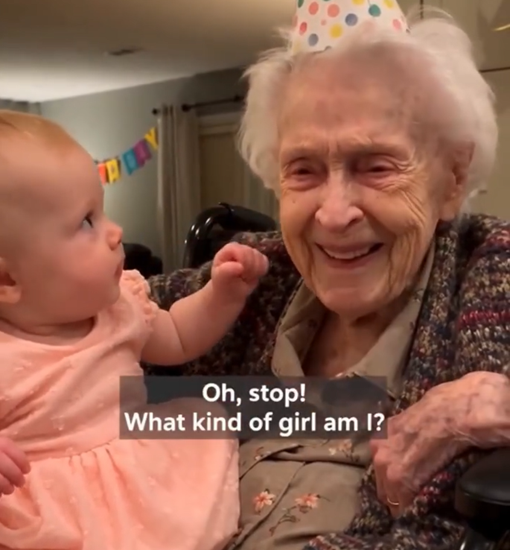
Everyone said my 101-year-old grandmother would never make it to the birthday party.
The journey was too long. The weather was unpredictable. Her health had become fragile, and even a short outing could leave her exhausted for days.
My mother suggested that we celebrate without her and bring her some photographs afterward.
My uncle thought the same thing.
Even my husband, Mark, gently reminded me that Grandma needed to rest.
But I couldn’t stop hoping she would come.
It was Lily’s first birthday, and I wanted the woman who had spent so many years loving our family to be there.
I wanted her to meet the little girl she had waited so long to hold.
I wanted one photograph with three generations of women together.
And, although I didn’t know it yet, Grandma had another reason for making the journey.
She had brought something with her.
Something she had been keeping for decades.
And she wasn’t going to let anyone open it until the right people were standing together.
The party was already underway when I noticed Grandma sitting beneath the old apple tree.
She was in her wheelchair, wearing a light cardigan and the small pair of earrings she always wore for special occasions.
Her face looked tired, but her eyes were bright.
My uncle stood behind her chair, making sure she was comfortable.
Mark sat beside her with one hand gently supporting Lily, who was balanced across Grandma’s lap.
Grandma no longer had the strength to hold a restless one-year-old safely on her own, but she didn’t seem bothered by that.
She was watching Lily as if nothing else in the garden mattered.
“She’s got your ears,” she said.
I laughed.
“That’s not exactly a compliment.”
“They’re good ears.”
“They stick out.”
“So did yours.”
“Exactly.”
Grandma smiled.
Then she gently touched Lily’s cheek with one finger.
“Worth waiting for.”
I felt my throat tighten.
There were some things Grandma could say in just a few words that stayed with me much longer than entire conversations.
That was one of them.
I had waited a long time to become a mother.
And she had waited a long time to meet my daughter.
Neither of us had known whether this moment would ever happen.
But there we were, beneath the same apple tree, with Lily smiling between us.
I thought that was the most meaningful part of the day.
I was wrong.
A little later, Grandma reached for my hand.
“Not yet,” she whispered.
I stopped.
“What is it?”
She kept her hand over mine.
“Wait until everybody’s here.”
I looked around the garden.
My uncle was there. Mark was beside her. Lily was playing with a ribbon on her dress, and most of our relatives had already gathered.
“Everybody is here, Grandma.”
She slowly shook her head.
“Your mother.”
I turned toward the house.
Mom was inside helping with the cake.
My uncle went to get her.
For reasons I couldn’t explain, my heart began beating faster.
Grandma had been unusually quiet all afternoon. She had also kept one hand close to a small package hanging from the side of her wheelchair.
I had noticed it when she arrived, but assumed it contained something ordinary.
Now I wasn’t so sure.
“What is in that bag?” I asked.
She looked at me.
“Something I’ve kept.”
“For how long?”
She smiled but didn’t answer.
That was when I realized this wasn’t simply a birthday present.
When Mom came outside, she was carrying the cake knife.
“What are we doing?” she asked.
Grandma pointed to an empty chair.
“Sit down.”
Mom frowned.
“Why?”
“Because I’m 101 and you still don’t do as you’re told.”
My uncle laughed.
Mom shook her head, but she sat beside us.
Grandma looked at me.
“Now.”
I reached for the package.
The tissue paper came away slowly, revealing a wooden box.
It was dark walnut, worn around the corners, with a small brass clasp.
I recognized it immediately.
“Oh my God.”
Mom leaned forward.
“What?”
“Grandma’s sewing box.”
For a moment, I was no longer standing in a garden surrounded by family.
I was a little girl again, sitting beside Grandma’s chair and watching her hands move through pieces of fabric.
That box had been part of her life for as long as I could remember.
It used to sit beside her favorite chair.
Inside were buttons separated into little compartments, needles carefully arranged, and spools of thread organized by color.
She could spend an entire afternoon repairing a loose hem or turning a piece of ordinary fabric into something beautiful.
I had always admired her patience.
I had never inherited it.
At the very bottom of that box, beneath everything else, she used to keep something wrapped in brown paper.
Whenever I asked what it was, she would tell me it wasn’t for children.
I had forgotten about it over the years.
Until that afternoon.
I looked at her.
“You brought this?”
“For Lily.”
My eyes began to fill.
“Grandma, she’s one. She can’t sew.”
Grandma gave me a familiar look.
“Neither could you at one.”
Mom laughed softly.
I opened the clasp.
And then I saw the first thing she had kept.
The top tray was filled with buttons.
There were pearl buttons, wooden ones, blue glass buttons, and tiny red ones shaped like flowers.
Some were so small that I wondered what kind of clothes they could possibly have belonged to.
I lifted the tray carefully.
Underneath were several folded pieces of fabric.
The first one was wrapped in a thin piece of tissue paper.
I opened it.
A small white dress appeared in my hands.
Yellow flowers had been embroidered around the collar.
For several seconds, I couldn’t speak.
I knew that dress.
I had seen it in a photograph beside Grandma’s chair for most of my childhood.
The picture showed me at four years old, standing on her front step.
I was wearing that exact dress.
My fingers moved over the tiny flowers.
“Grandma…”
She watched my face.
“You kept it?”
“Of course I kept it.”
“For 38 years?”
“Things don’t spoil just because people get older.”
I laughed, but my eyes were already filling with tears.
Mom leaned closer.
She remembered the photograph too.
For years, it had been one of Grandma’s favorite pictures.
She used to point at it whenever someone visited and tell them how little I had been.
I had never really understood why she loved that photograph so much.
Now I was beginning to understand.
But there was something else beneath the first dress.
I carefully lifted the next layer.
This time, the fabric was pale blue.
It was another little dress, smaller than the first, with tiny covered buttons running down the back.
The stitching was delicate and even.
Mom made a sound I had never heard from her before.
She reached toward it with trembling fingers.
“My dress.”
I looked at her.
“What?”
Grandma nodded.
“Your mother wore that when she was two.”
Mom pressed the fabric gently against her mouth.
For a moment, she couldn’t say anything.
The dress was more than sixty years old.
Grandma had made it by hand, carefully smocking the fabric and covering each tiny button.
Mom had probably spent decades believing it existed only in an old photograph or in a distant memory.
Now she was holding it again.
“All these years,” Mom whispered.
Grandma looked at her.
“I wasn’t going to throw it away.”
Mom shook her head.
“I know.”
I looked from the blue dress to the white one.
“Did you make both of them?”
“Yes.”
“By yourself?”
Grandma raised an eyebrow.
“Who else was going to make them?”
My uncle chuckled.
Mom was still holding the blue dress.
Then Grandma pointed toward the bottom of the box.
“Keep going.”
Beneath my mother’s dress was another piece of fabric wrapped in tissue paper.
I unfolded it carefully.
It was a cream-colored linen dress with tiny green leaves stitched along the hem.
It looked newer than the others.
But something was different.
The dress wasn’t finished.
One sleeve had been attached.
The other was missing.
A few pins held part of the collar in place.
I stared at it.
For a moment, I couldn’t understand why Grandma would have brought an unfinished dress to Lily’s birthday.
Then she spoke.
“That’s hers.”
I looked at Lily.
Then back at Grandma.
“You made this?”
“Started it.”
“When?”
She looked away.
“Years ago.”
Mom’s expression changed.
“How many years?”
Grandma didn’t answer her.
Instead, she pointed toward the little dress.
“Look in the pocket.”
I examined the fabric.
At first, I couldn’t see a pocket.
Then I noticed a small fold sewn into the inside near the waist.
I slipped my fingers inside.
There was something hidden there.
An envelope.
My name was written across the front.
I recognized Grandma’s handwriting immediately.
But it was shakier than I remembered.
I held it between my fingers.
“What’s this?”
“Open it,” she said.
I looked at her.
She nodded.
And suddenly, the entire garden seemed quieter.
The envelope opened easily.
Inside was a folded letter.
The first line made my hands tremble.
“For the baby I hope I live long enough to meet.”
I stopped reading.
I looked at Grandma.
She was watching me carefully.
Mom had moved closer, and Mark was now crouching beside my chair.
I read the line again.
Then I covered my face.
I knew what the letter was about.
I remembered the conversation that had taken place years earlier.
I remembered the kitchen.
I remembered the tears.
And I remembered how Grandma had listened without trying to make everything better.
But I hadn’t known that she had gone home afterward and started making a dress.
I hadn’t known she had been preparing something for a child who didn’t yet exist.
I was 34 when I first told Grandma how frightened I was that I might never become a mother.
Mark and I had been trying for two years.
We had already gone through the disappointment of unsuccessful fertility treatment.
We had learned to wait for appointments, test results, and difficult conversations.
We had also learned how painful it could be to hear people ask when we were planning to have children.
Most of the time, I tried to avoid discussing it.
I didn’t want every family gathering to become another conversation about something I couldn’t control.
But one afternoon, I found myself sitting in Grandma’s kitchen.
She was making tea.
I was looking at the table, trying to find the words.
Finally, I said what I had been thinking for months.
“Maybe this just isn’t going to happen for me.”
Grandma put down the cup.
She didn’t tell me to relax.
She didn’t tell me that everything happened for a reason.
She didn’t promise that I would become pregnant.
She simply reached across the table and took my hand.
“Maybe,” she said.
I looked at her.
“But today isn’t every day.”
That was all.
I remember those words because they didn’t make me feel as though I had to pretend to be hopeful.
She wasn’t asking me to stop being sad.
She was reminding me that I didn’t have to decide what the rest of my life would look like based on one difficult day.
We finished our tea.
We talked about other things.
And eventually, I went home.
I never knew what Grandma did after I left.
Until I opened that letter.
I looked down and continued reading.
“My darling girl,
“You once told me you were frightened you might never become a mother.
“I did not know what to say because there are some pains you cannot fix by finding the correct sentence.
“So I went home and did the only useful thing I could think of.
“I started a dress.”
I stopped.
The garden blurred in front of me.
I looked at the unfinished cream-colored fabric.
The green leaves were stitched carefully along the hem.
I imagined Grandma sitting in her chair, choosing the thread, cutting the fabric, and working on it whenever her hands allowed.
She had started it after that conversation.
She had done it without telling me.
I continued.
“I did not make it because I knew you would have a baby.
“I made it because hope needs somewhere to sit while it waits.”
I lowered the letter.
My mother was crying.
Mark gently squeezed my hand.
Grandma kept watching me.
I took a breath and read the next lines.
“If no baby ever wore it, that would not make your life smaller.
“You were never waiting to become enough.
“But if one did come, I wanted that child to have something made before she was even known.”
I couldn’t continue immediately.
I had spent so many years believing that I had to protect myself from disappointment by expecting the worst.
Grandma had somehow understood that.
She had never tried to force me into optimism.
Instead, she had made something with her hands and left room for a possibility.
Not a promise.
Not a prediction.
Just a little dress.
I wiped my eyes and continued.
“I finished most of it when I was 94.
“Then my hands got worse.
“I left the sleeve because I thought perhaps one day you could finish something I started.”
I looked at the unfinished sleeve.
“Grandma, I’m terrible at sewing.”
She smiled.
“I know.”
Everybody laughed.
Even Mom managed a small smile through her tears.
I went back to the letter.
“The other dresses belong to your mother and to you.
“Three little girls.
“Three different times.
“If I am lucky enough to meet yours, put her in whichever one fits.
“Do not save them so carefully that nobody gets to live in them.”
I paused.
Then I read the next lines.
“Clothes are meant to wrinkle.
“Children are meant to stain things.
“Love is not improved by keeping it untouched.”
I lowered the page.
Those words reached somewhere deeper than I expected.
Because I had spent Lily’s first year being afraid.
Not every minute.
Not every day.
But often enough that Mark had noticed.
After losing a pregnancy at fourteen weeks, I had found it difficult to trust happiness.
When Lily was born, I counted her breaths.
I checked the monitor again and again.
I woke Mark because I thought she felt too warm.
Then I woke him because I thought she felt too cold.
I researched every little rash, every unfamiliar sound, and every change that made me worry.
I had wanted her for so long.
Sometimes, when I held her, I felt as though I had been handed something incredibly precious that I might somehow lose if I wasn’t careful enough.
I loved her more than I could explain.
But I was still learning how to enjoy being her mother without allowing fear to take up every available space.
Grandma had noticed.
Of course she had.
She had spent more than a century watching people grow, worry, celebrate, and change.
She knew that love could sometimes make people hold on too tightly.
And she wanted me to remember that Lily was a child.
She was supposed to explore.
She was supposed to make a mess.
She was supposed to live.
The letter wasn’t finished.
I unfolded the remaining page.
“And one more thing.
“Stop looking frightened every time that child climbs something.
“You climbed everything.
“Your mother was worse.”
Mom immediately protested.
“That is a lie.”
Grandma looked at her.
“You climbed onto a garage roof at eight.”
“I was retrieving a ball.”
“You used the drainpipe.”
“I was resourceful.”
My uncle started laughing.
I laughed too.
For a moment, the tears gave way to the kind of laughter that comes from remembering someone exactly as they are.
Grandma had always been like that.
She could make a serious moment lighter without making the feelings disappear.
I looked down at the last paragraph.
It was shorter than the others.
“If I am there when this is opened, somebody give me the baby.
“If I am not, tell her I waited a very long time to meet her.
“And tell her I was glad she came.”
I couldn’t finish the signature.
I folded the letter against my chest.
Then I leaned forward and carefully put my arms around Grandma.
She felt so small.
For most of my life, she had seemed strong enough to carry anything.
She carried laundry baskets, moved furniture, and picked me up when I was far too old to be lifted.
Now I was afraid that even a hug might hurt her.
She patted my back.
“You’re making a scene.”
“You wrote the letter.”
“Years ago.”
“That’s worse.”
She laughed softly.
And then Lily reached toward the box.
Naturally, her first target was a blue glass button.
“No,” three generations of women said at once.
Everybody laughed again.
We had cake about twenty minutes later.
Grandma refused a full slice.
Then she ate half of mine.
She stayed for less than two hours because that was all her body could manage.
By the time my uncle began preparing to take her home, her face had grown pale.
I walked beside her wheelchair.
“Was this worth it?”
She looked at me as if I had asked the most ridiculous question in the world.
“Obviously.”
“The drive nearly killed you.”
“Everything nearly kills you at 101.”
“Grandma.”
She reached for my hand.
“I wasn’t going to sit at home because it was difficult.”
I swallowed.
“You could have gotten sick.”
“I could get sick in my own chair.”
I didn’t have an answer.
At the car, she looked back toward the garden.
Lily was sitting in the grass, smashing birthday cake between both hands.
Grandma smiled.
“There.”
“What?”
“That’s what I wanted.”
I looked at my daughter.
Then I remembered the old photograph.
Me at four years old, standing on Grandma’s front step in the little white dress.
“I thought you wanted a picture of her on your step,” I said.
“I do.”
“You just said that’s what you wanted.”
“I can want two things.”
Even at 101, Grandma was still capable of having the final word.
We helped her into the car.
It took my uncle and Mark working together to make her comfortable.
Before the door closed, she called my name.
I leaned down.
“Finish the sleeve.”
I looked toward the sewing box.
“I’ll try.”
“No.”
Her hand tightened around mine.
“Don’t try. Finish it.”
That was Grandma.
She had never been interested in half-finished promises.
I nodded.
“I will.”
She smiled.
Then the door closed.
I stood in the road crying until the car disappeared.
Three days later, Mom and I went to Grandma’s house.
She was exhausted after the party, although she wasn’t ill.
She slept for much of that week.
The sewing box came home with me.
So did the unfinished dress.
I placed everything on the dining-room table and opened the box again.
The dresses looked different in the daylight.
The white one reminded me of my childhood.
The blue one reminded me that Mom had once been a little girl too.
And the cream one reminded me of a conversation I had almost forgotten.
I looked at the unfinished sleeve.
Grandma had left it for me.
I had promised her I would finish it.
There was only one problem.
I had no idea how.
I bought a beginner sewing kit.
It was more complicated than I expected.
I watched instructional videos.
I read instructions.
I tried to understand which thread went where and how to keep the fabric from moving while I worked.
I called Mom.
She wasn’t much help.
“I thought Grandma taught you,” she said.
“She tried.”
“What happened?”
“I hated it.”
Mom laughed.
“So did I.”
Apparently, we came from a long line of women who had benefited from one woman’s sewing skills while refusing to learn the craft themselves.
Eventually, my uncle found Grandma’s old sewing machine in a closet.
Grandma couldn’t use it anymore, but she could still tell me exactly what I was doing wrong.
I took the dress to her.
She examined my first attempt at the sleeve.
“This seam is terrible.”
“I know.”
“Take it out.”
“It took me two hours.”
“Then you’ll be faster the second time.”
I stared at her.
She smiled.
For the next six weeks, I worked on the dress whenever I had time.
Sometimes I managed twenty minutes after Lily went to sleep.
Other nights, I worked until midnight.
I redid the sleeve twice.
I worked on the collar three times.
There were moments when I wanted to put everything back into the wooden box and leave the dress unfinished.
It would have been easier.
I could have told myself that the unfinished sleeve was part of the memory.
But every time I considered giving up, I remembered Grandma’s voice.
“Don’t try. Finish it.”
So I kept going.
When Lily was thirteen months old, we took her to Grandma’s house.
I had finally finished the dress.
It wasn’t perfect.
The sleeve was attached, but the stitching wasn’t nearly as neat as Grandma’s.
The collar had taken me several attempts.
The hem was a little longer than I had planned.
Still, the dress was complete.
And it fit Lily almost perfectly.
I dressed her in it before we left.
Mark helped me gather the sewing box and the old photographs.
Mom had already arrived at Grandma’s house.
She was holding the picture of me at four years old, wearing the white dress.
Grandma was waiting inside the doorway in her wheelchair.
When she saw Lily, she looked at the dress first.
Then she looked at me.
“Well?”
“It’s finished.”
She nodded.
“Let me see.”
I turned Lily gently so Grandma could examine the sleeve.
She studied the stitching.
I waited for her criticism.
She looked at it for a long moment.
Then she said, “Not bad.”
Coming from Grandma, that was practically a standing ovation.
I laughed.
“You can say it’s good.”
“I could.”
“But?”
She smiled.
“Not bad.”
Mom laughed beside us.
Then we carried Lily outside to the front step.
The same step where I had stood in the old photograph.
Lily immediately tried to crawl away.
“Of course,” I said.
Mom laughed.
“Put something in front of her.”
Grandma suggested giving her a button.
“A big one.”
“No buttons,” I said.
“You’re no fun,” Grandma replied.
Mark stood behind the camera and made ridiculous noises until Lily finally looked up.
For one brief second, she was still.
Click.
We got the photograph.
Later, we placed the two old photographs beside the new one.
There was me at four, wearing the yellow-flowered white dress.
There was Mom at two, wearing pale blue.
And there was Lily at one, wearing cream and green.
Three little girls.
Three different times.
Three dresses made by the same pair of hands.
The photographs showed three generations of our family connected by something Grandma had created long before she knew how the story would turn out.
Grandma stared at the new picture on my phone.
She looked at it for a long time.
Then she handed it back.
“Print it.”
“I will.”
“People don’t print things anymore.”
“I print things.”
“You have 8,000 pictures on that phone.”
“How do you know?”
“You told me.”
Fair enough.
I printed it that afternoon.
I chose a large frame and placed the photograph inside.
The next time I visited Grandma, it was on the little table beside her chair.
The old photograph of me had been moved slightly to the left.
There was just enough room for both.
I didn’t say anything.
Neither did she.
But I knew she was happy.
Grandma died four months later.
She was 101 years and seven months old.
It happened quietly, in her own bed.
My mother was there.
So was my uncle.
I arrived twenty minutes too late.
For a long time, that bothered me.
I kept thinking about all the things I would have said if I had arrived earlier.
I wanted one more conversation.
One more ridiculous instruction.
One more opportunity for her to look at something I had done and tell me how to improve it.
I wanted to hold her hand and thank her again for the dress.
But eventually, I began to understand something.
Grandma had spent years saying goodbye in pieces.
The sewing box.
The letter.
The unfinished dress.
The birthday party.
The photograph.
She had given us something to hold on to before we even understood that we would need it.
And she had made it to Lily’s first birthday.
She had made it into the photograph.
She had seen the dress finished.
She had held the child she had waited so long to meet.
That mattered.
The sewing box still lives in my house.
I keep it somewhere safe, but not somewhere unreachable.
I don’t want it to become another object that is so carefully protected that nobody gets to enjoy it.
The cream dress has already been stained.
Strawberry, I think.
The white dress I wore as a child has a tiny tear near the waist.
Lily wore it for family photographs one spring and caught it on a branch.
For about five seconds, I was devastated.
Then I remembered Grandma’s words.
“Clothes are meant to wrinkle.”
“Children are meant to stain things.”
So I repaired it.
Badly.
But well enough.
And that was enough.
Lily is still too young to understand the story behind the three dresses.
One day, I will show her the photographs.
I’ll tell her about the woman who sat beneath an apple tree at 101 years old, waiting for her mother to arrive so she could open a wooden box.
I’ll show her the letter.
I’ll explain that before Lily existed, her great-grandmother had begun making her a dress.
She didn’t know whether a baby would ever wear it.
She didn’t know when it might be finished.
She simply wanted to make something that could be passed from one generation to another.
I’ll tell Lily that the dress wasn’t perfect when it was first made.
It needed a sleeve.
It needed patience.
And eventually, it needed another pair of hands.
Maybe I’ll tell her about the six years we tried to have her.
Maybe not all at once.
Some stories belong to children when they are old enough to understand them.
But I want her to know that she was loved long before she was born.
Not because anyone knew she would arrive.
Not because anyone could promise what the future would bring.
Simply because someone had made room for the possibility.
On Lily’s second birthday, we kept the celebration smaller.
There was cake, a paddling pool, too many balloons, and more family food than anyone could finish.
At one point, Lily ran through the garden wearing nothing but a diaper and one of Grandma’s old necklaces.
Mom started to say, “Careful with that.”
Then she stopped.
We looked at each other.
For a moment, neither of us said anything.
I knew exactly what she was thinking.
Grandma would have hated us hovering over Lily every second.
She would have wanted us to let her explore, laugh, and get a little messy.
Mom sighed.
“Fine.”
Lily ran away laughing.
And we let her.
Later that evening, after everyone had gone home, I sat in the garden with the sewing box beside me.
I opened it again.
I had looked through it many times since Grandma died, but that night I noticed something I had somehow missed.
At the bottom, underneath the dresses, there was a tiny scrap of cream fabric.
I lifted it carefully.
On it were several attempts at the little green leaf pattern Grandma had eventually stitched along Lily’s hem.
The first leaf was crooked.
The second was worse.
The third was almost right.
I stared at it for a long time.
Grandma had been sewing for nearly ninety years when she made Lily’s dress.
And she had still practiced first.
That small piece of fabric changed the way I thought about her.
For most of my life, I had imagined that Grandma knew how to do everything without being afraid or uncertain.
She always seemed to know what to do.
She could repair almost anything.
She could make something beautiful out of scraps.
She could comfort someone without making them feel weak.
But perhaps she had never been as certain as I imagined.
Perhaps she had simply learned to keep going.
She made mistakes.
She tried again.
She took out stitches that weren’t right.
And then she made another one.
I framed the little scrap of fabric too.
Not because it was beautiful.
But because it reminded me that even the most skilled hands had once needed practice.
I think about that now whenever motherhood frightens me.
Whenever Lily climbs too high.
Whenever she gets sick.
Whenever I feel the old panic telling me to hold on too tightly because I waited so long to have her.
I remember a 101-year-old woman making a long journey because missing a birthday mattered more to her than the inconvenience of getting there.
I remember her sitting beneath the apple tree, holding Lily carefully while Mark supported her.
I remember the way she looked at my daughter.
And I remember the unfinished sleeve.
Grandma didn’t need to finish every part herself.
She only needed to leave enough for me to continue.
Maybe that is what families are.
Not perfect things kept untouched inside beautiful boxes.
Not photographs that never change.
Not clothes that remain clean forever.
Maybe families are the things we make, repair, pass along, and sometimes have to finish together.
They are the stories told around kitchen tables.
The old photographs that get moved to make room for new ones.
The lessons we don’t fully understand until years later.
And the little pieces of love that someone leaves behind without knowing exactly how they will be used.
The sewing box is still in my house.
Sometimes Lily opens it with me and looks at the buttons.
I keep the smallest ones out of her reach.
The dresses are folded carefully, but I no longer treat them as if they must never be touched.
Because Grandma taught me something I wish I had understood earlier.
Love is not made more valuable by keeping it untouched.
Sometimes, the best way to honor something beautiful is to let it become part of everyday life.
To let it wrinkle.
To let it be worn.
To let it be repaired when necessary.
And to keep passing it on.
The little cream dress is not perfect.
My stitching is uneven.
The sleeve is not as neat as Grandma would have made it.
But when I look at Lily wearing it, I don’t see the mistakes.
I see a woman who started sewing for a child she had never met.
I see a mother who once wore a pale blue dress.
I see a little girl standing on a front step in a white dress with yellow flowers.
And I see the hands that connected all three of us.
Grandma waited a very long time to meet Lily.
She made it to the birthday.
She gave us the box.
And, in her own way, she left us something that would keep teaching us long after she was gone.
I used to think the most important part of that story was that Grandma had finished the dress.
Now I think it was something else.
She had started it without knowing how the story would end.
And she trusted that, one day, someone else would take it from there.