I never imagined I would stand at my daughter’s wedding and watch her marry a man I had once called my husband. I thought I had experienced the most painful moments life could offer when my first marriage ended.
I was wrong. Nothing prepared me for the moment I realized my daughter was about to repeat a chapter of my life I had spent years trying to close. And nothing prepared me for what my son would reveal that evening.
For a long time, I believed the hardest part would be accepting the relationship. I thought I would have to learn how to smile through family dinners, how to sit beside them without remembering my own marriage, and how to pretend the situation didn’t make me uncomfortable.
But I never imagined the truth would emerge during the wedding reception, in front of the very people who had come to celebrate their happiness.
To understand why that evening changed everything, I have to go back to the beginning.
I was twenty years old when I married Mark. We came from families that had known one another for years, families that valued appearances, traditions, and the kind of reputation that was carefully maintained at every gathering.
Our parents had been friends long before we became a couple.
They attended the same charitable events, spent holidays together, and knew the same people. By the time Mark and I began dating seriously, it almost felt as though everyone had already decided what our future would look like.
We were young, but no one seemed concerned about whether we were truly ready.
Everyone thought we were a perfect match.
We had similar backgrounds, comfortable lives, and families who approved of the relationship. There were no obvious reasons for anyone to question our decision. When we announced our engagement, people congratulated us as though something expected had finally happened.
My wedding dress was chosen with my mother’s help.
The venue was beautiful. The flowers were arranged perfectly, and every detail seemed to have been planned months in advance. I remember smiling for photographs, greeting relatives, and trying to absorb the feeling of being surrounded by people who believed I was beginning a wonderful life.
At the time, I believed them.
I thought marriage would naturally become easier as we grew older. I assumed that love, responsibility, and shared experiences would eventually bring us closer together.
I didn’t understand that two people could live under the same roof for years and slowly become strangers.
Our daughter Rowan was born the same year we married. Two years later, we welcomed Caleb. They became the center of our lives, and for a while, having children gave us something we could both focus on.
Our home was busy.
There were toys scattered across the living room, school schedules on the refrigerator, family photographs on the walls, and countless little responsibilities that filled every day. From the outside, we looked like the family everyone expected us to be.
We took holiday pictures.
We attended gatherings, hosted dinners, and celebrated birthdays. I learned how to smile for photographs even when I was tired, how to make conversation when my mind was somewhere else, and how to answer questions about our marriage without revealing how distant we had become.
But behind those photographs, something was missing.
Mark and I were no longer talking about the things that mattered. We discussed schedules, bills, children, invitations, and responsibilities. We rarely talked about our dreams, our fears, or the things we wished our lives could become.
Our conversations became practical.
And somehow, the silence between those conversations became even more difficult.
We weren’t constantly fighting. In fact, we barely argued at all. That was part of the problem. We had become so careful not to upset one another that we stopped being honest about what we felt.
Whenever something bothered me, I kept it to myself.
Whenever Mark seemed unhappy, I assumed he would tell me if it mattered. Days passed, then months, and eventually we became comfortable pretending everything was fine.
Neither of us knew how to begin fixing something we had spent so long refusing to acknowledge.
Our families expected us to remain together. Divorce was not something they discussed casually, and the idea of separating seemed to carry more weight than simply admitting a marriage was no longer working.
We were expected to be grateful.
We had children, a beautiful home, and opportunities many people would have wanted. I sometimes wondered whether I had the right to feel unhappy when so much of our life looked perfect.
That question kept me silent longer than it should have.
Years passed. Rowan and Caleb grew older. Our responsibilities changed, but the distance between Mark and me never truly disappeared.
Eventually, we had a conversation we had avoided for years.
There was no dramatic argument. No screaming across the house. No sudden revelation that one of us had been living a secret life.
We simply admitted that our marriage had become something neither of us knew how to repair.
After seventeen years, we decided to divorce.
Our parents were devastated. They had imagined us growing old together, attending family celebrations, and watching our children build families of their own. They struggled to understand how a marriage that looked so stable could quietly come to an end.
But when the papers were signed, I felt something I hadn’t felt in a long time.
Relief.
It wasn’t happiness about the divorce. It was the relief of finally being honest about the life we had been living.
Mark and I didn’t turn our separation into a war. We were still the parents of two children, and neither of us wanted Rowan or Caleb to feel responsible for what had happened.
We moved forward separately.
For the first time in years, I had to think about who I was outside the role of wife, mother, and daughter in a family that always seemed to have expectations.
I wasn’t sure what that would look like.
Then, five years later, I met Arthur.
He was different from the men I had known before. He didn’t seem interested in impressing people or making every conversation sound polished. He spoke quietly, listened carefully, and had a way of making ordinary moments feel meaningful.
Arthur was thirty-eight, a high school teacher, divorced, and raising three children of his own.
He loved poetry and classic cars. He had a sense of humor that was sometimes ridiculous, and he didn’t seem embarrassed by the imperfections of his life.
For the first time, I found myself enjoying conversations that had nothing to do with appearances.
We talked about parenting.
We talked about the mistakes we had made, the lessons we had learned, and the things we wished we had understood when we were younger. Sometimes we talked for hours without realizing how late it had become.
I didn’t feel the need to impress him.
I could admit when I was tired. I could disagree with him. I could laugh at myself without worrying about whether someone would judge me.
After years of feeling like I was performing the role of a perfect wife, that kind of freedom was unfamiliar.
And I found myself wanting more of it.
Our relationship moved quickly.
Perhaps we were both tired of starting over. Perhaps we mistook comfort for certainty. Whatever the reason, we didn’t give ourselves much time to discover what our relationship might look like under the pressures of everyday life.
We got married.
At first, I believed I had finally found the kind of relationship I had been missing.
But something changed after the wedding.
Arthur began pulling away from the practical parts of our life together. He stopped suggesting plans for the future. Date nights became less frequent. Conversations that once lasted hours began ending with short answers.
I kept trying to understand what was happening.
I wondered whether blending two families had become more complicated than he expected. I wondered whether he was struggling with responsibilities involving his children. I even questioned whether I was expecting too much from a relationship that had begun so quickly.
I tried to talk to him.
Sometimes he listened, but nothing seemed to change for long. I was left feeling as though I were trying to hold together a marriage that was slowly slipping away without either of us admitting it.
After six months, we separated.
There were no explosive fights or dramatic accusations. We simply reached a point where continuing the marriage didn’t seem right.
We told people it was mutual.
At the time, I believed that explanation. I thought we had rushed into something, discovered that it wasn’t what either of us needed, and decided to let each other go.
We wished each other well.
I thought Arthur would become another chapter in my past, someone I would occasionally remember without feeling anything particularly strong.
I had no idea how wrong I was.
Two years passed.
My children were building their own lives. Rowan had always been determined, ambitious, and independent. She knew what she wanted, and she wasn’t someone who easily changed her mind because another person disagreed.
At twenty-four, she had earned her MBA and was working at a competitive marketing firm. She was busy, confident, and proud of the life she was creating.
One afternoon, she asked if we could sit down and talk.
I remember the way she looked when she entered the living room. Her cheeks were flushed, and she had a smile that seemed impossible to hide.
“Mom, I’m in love,” she said.
I smiled before I even knew who she was talking about.
“That’s wonderful,” I answered. “Tell me everything.”
She began describing him. She talked about how easy it was to communicate with him, how he understood her, and how she felt that she could finally be herself around someone.
I listened, happy to see my daughter excited about something.
Then she said his name.
“Arthur.”
At first, I thought I had misunderstood.
“Arthur who?”
She gave me a look, almost as though she expected me to know.
“You know. Arthur.”
My stomach tightened.
“Do you mean my Arthur?”
She nodded.
I remember the silence that followed. I could hear her continuing to talk, but I wasn’t processing the words. My mind was trying to catch up with what she had just told me.
My daughter was dating my former husband.
The man I had married after Mark.
The man I had been with for six months.
And now, the man Rowan said she wanted to spend her life with.
I tried to remain calm. I didn’t want my reaction to become a reason for her to shut me out. But I couldn’t pretend the situation was ordinary.
Arthur was forty years old.
Rowan was twenty-four.
There was a sixteen-year age difference, and there was also the history between Arthur and me. I had known him as my husband. I had shared a home with him, made plans with him, and eventually watched those plans fall apart.
My daughter knew some of that history.
But she saw Arthur differently.
She told me he had reached out to her after our marriage ended. They began talking, and over time, their conversations became something more. She believed their connection was genuine.
I asked questions.
She answered with the confidence of someone who had already made up her mind.
Then she said something that hurt more than I expected.
“You either accept this, or I cut you out of my life.”
I stared at her.
I wanted to tell her how wrong it felt. I wanted to remind her that the man she was describing was someone I had once married, someone whose behavior had left me confused and disappointed.
But the thought of losing my daughter frightened me more than the thought of keeping my feelings to myself.
So I did something I would later question.
I told her I supported her.
I said I wanted her to be happy. I tried to smile. I tried to behave as though I could accept the situation without any reservations.
But the truth was that I was deeply uncomfortable.
I had questions I didn’t know how to ask without making her feel attacked. I worried that if I pushed too hard, she would stop listening entirely.
So I kept my concerns to myself.
I hoped time would tell us whether the relationship was truly what Rowan believed it to be.
A year later, the wedding arrived.
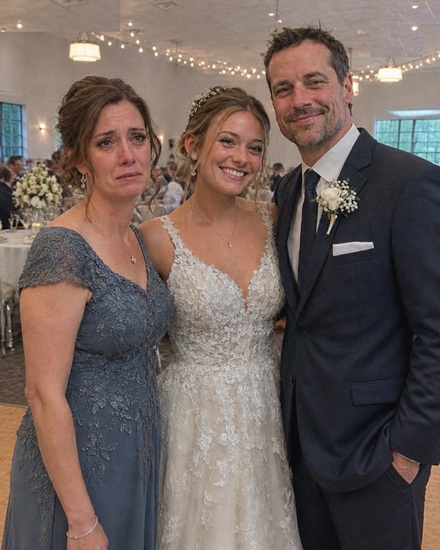
The venue was decorated with eucalyptus garlands, flowers, and soft lighting. Music played while guests gathered, greeting one another and taking photographs.
Rowan looked beautiful in her ivory dress.
She was smiling, excited, and completely focused on the day she had planned. Arthur stood beside her looking proud, and everyone around them seemed caught up in the celebration.
I was there as her mother.
I smiled for photographs. I congratulated guests. I raised my glass when people toasted the couple. I did everything I could to make sure Rowan felt supported.
But beneath the smile, I was struggling.
Every time I looked at Arthur, memories came back. I remembered our conversations before we married. I remembered the way he had gradually stopped making plans with me.
I wondered whether my daughter knew everything she needed to know about him.
I wondered whether she had asked the questions I had once been too uncomfortable to ask.
And I wondered whether my silence had made it easier for her to believe there was nothing to worry about.
I kept those thoughts to myself.
It was her wedding day, and I didn’t want to create a scene. I didn’t want my personal feelings to become the center of a celebration that belonged to her.
I told myself I would get through the evening.
Then Caleb found me.
My son had always been quieter than Rowan, but quiet didn’t mean he was unaware of what was happening around him. He was steady, thoughtful, and rarely acted without considering the consequences.
At twenty-two, he had already started a small tech company. He was independent, responsible, and the kind of person who remembered to check on his grandparents every Sunday.
When he approached me during the reception, I could tell from his expression that something was wrong.
“Mom, we need to talk.”
I looked at him.
“What is it?”
He glanced toward the wedding table, where Rowan and Arthur were sitting together.
“Come with me. I’ll show you something.”
I followed him.
We walked away from the reception, past the tables and the guests, until we reached the parking lot. The music became quieter behind us.
The evening air felt cold against my skin.
I could hear my heels clicking against the pavement as I tried to keep up with him.
“Caleb, what is going on?”
He didn’t answer immediately.
Instead, he took out his phone and opened a few folders. He seemed to be checking that everything was in the right place before he said anything.
“I waited until today because I needed all the information,” he finally said.
My confusion grew.
“What information?”
He took a breath.
“I hired a private investigator.”
I stopped walking.
“You did what?”
Caleb explained that he had become uncomfortable with Arthur’s behavior. He said there were things about the way Arthur spoke and acted that didn’t seem right to him.
He had also noticed changes in Rowan.
She had become more distant from some people in her life. She seemed increasingly focused on Arthur, and Caleb said the situation reminded him of the way Arthur had behaved during my marriage.
He didn’t want to accuse anyone based on a feeling.
He wanted evidence.
That was why he had spent time gathering information.
I felt a wave of anger and fear.
“Why didn’t you tell me sooner?”
“I needed to know whether I was wrong,” he said. “I didn’t want to ruin her wedding because I was suspicious of him.”
He looked down at his phone.
“Mom, I don’t think Arthur is who he says he is.”
My heart began beating faster.
“What do you mean?”
Caleb showed me documents.
They were not gossip posts or anonymous messages. He said the information came from legal records and investigative summaries he had gathered.
I stared at the pages, trying to understand what I was seeing.
Arthur had reportedly filed for bankruptcy two years before he met me.
There were records involving defaulted business loans, credit cards that had gone into collections, and unpaid taxes. There was also a lawsuit involving his former wife that described financial disputes and missed alimony payments.
I read the documents again.
I could hardly believe what Caleb was telling me.
“Are you saying he’s using Rowan?”
Caleb looked at me.
“That’s what I believe. He’s not telling her the truth about his financial situation.”
He explained that Arthur’s financial history had not been disclosed to Rowan. He was concerned that my daughter was making a major decision without knowing the details of the man’s past.
I felt sick.
I thought back to my own marriage to Arthur.
Before we married, I had insisted on a prenuptial agreement. It wasn’t because I had expected him to do something wrong. I had already been through a divorce, and I knew how complicated financial matters could become.
Arthur had hesitated.
He said a prenup made love feel less romantic.
I told him that if our relationship was built on trust, then an agreement shouldn’t be a threat.
Eventually, he signed it.
At the time, I didn’t think much of his hesitation. I assumed he simply didn’t like the idea of discussing finances before marriage.
Now, standing in the parking lot while my son showed me these records, I began looking at that memory differently.
Caleb touched my arm.
“We have to tell her.”
I shook my head.
“She won’t believe us. Not now.”
Rowan had already made it clear that she would defend Arthur. If we confronted her privately, she might think we were trying to ruin her marriage because of our own history.
She might refuse to listen.
And if Arthur knew we were questioning him, he could turn the conversation into an argument about jealousy or resentment.
Caleb looked at me.
“Then we need to show her.”
I knew what he meant before he finished speaking.
He wanted to bring the information into the open.
I hesitated.
A wedding reception was not the place for a confrontation. I imagined Rowan’s face, the guests, the photographs, the moment her celebration suddenly became something else.
But I also thought about what might happen if we remained silent.
What if the documents were accurate?
What if Rowan discovered the information months later, after making financial commitments or decisions that were difficult to reverse?
I had spent years trying not to interfere in my children’s lives.
But this felt different.
I looked at Caleb and finally nodded.
“If we’re going to do this,” I said, “we need to be certain of what we’re showing her.”
He agreed.
We returned to the reception.
The room was warm, bright, and full of laughter. Guests were dancing, talking, and raising glasses. Rowan was sitting beside Arthur, looking happier than I had seen her in a long time.
For a moment, I almost turned around.
I wanted the evening to remain beautiful for her. I wanted her to have the wedding she had imagined, even if I couldn’t fully understand her decision.
But Caleb had already gathered the documents.
And we had reached a point where doing nothing felt worse.
He asked me one last time whether I was sure.
I looked at my daughter.
“Yes.”
We walked back into the room.
The emcee had finished one of the announcements, and people were beginning to settle down again. Caleb approached the small stage where the microphone was placed.
He was introduced as Rowan’s brother.
At first, people smiled, expecting a traditional wedding speech. Some guests lifted their glasses. Rowan looked toward him with an excited expression.
Caleb stood there calmly.
I could see the tension in his shoulders.
He began by congratulating his sister.
He spoke about marriage, trust, honesty, and the importance of building a life with someone who genuinely respected you.
The room was quiet enough to hear him clearly.
Then he turned toward Arthur.
“Arthur, I have a question for you.”
A few guests laughed softly, assuming it was part of the speech.
Caleb continued.
“How is your former wife doing? Is she still waiting for the alimony payments?”
The laughter stopped.
Some guests looked at one another. Arthur’s expression changed almost immediately.
Caleb didn’t pause.
He asked about the legal disputes, the financial problems, and the bankruptcy filing. He mentioned the records he had found and questioned why those matters had not been discussed with Rowan before the wedding.
The room became increasingly uncomfortable.
Rowan’s smile faded.
Arthur looked as though he had been caught completely off guard.
Caleb then held up his phone.
He explained that the information he was referring to came from legal records, not rumors. He said the records were available for review and that he had gathered them because he didn’t want his sister entering a marriage without knowing about matters that could affect her future.
I stood frozen.
I could hear people whispering.
I could see Rowan looking from Caleb to Arthur, trying to understand what was happening.
Then Caleb asked the question that seemed to change the entire room.
“When were you planning to tell her? After the wedding? After the honeymoon? Or not at all?”
Nobody answered.
Arthur opened his mouth, then closed it.
Rowan stood up slowly.
Her face had changed. She was no longer smiling. Her eyes were moving between the documents and Arthur, searching for an explanation that would make sense.
Then she spoke.
“Is it true?”
Arthur finally responded.
“I… it’s complicated, my love.”
Those words seemed to be all Rowan needed.
She shook her head.
“No. It’s not.”
She turned toward me.
“Mom…”
Her voice broke.
I moved toward her, and she fell into my arms. For a moment, neither of us said anything. I could feel her trembling, and I held her as tightly as I could.
She had walked into that wedding believing she was beginning a new life.
Now she was standing in the middle of a room full of people, trying to understand whether the man she trusted had hidden important information from her.
She walked out of her own wedding.
The reception was no longer a celebration.
Guests began whispering, some rising from their seats, others looking toward Arthur. The room that had been full of music and laughter only moments earlier felt completely different.
Caleb announced that the wedding was over.
People began leaving.
Arthur moved through the crowd, seemingly trying to find a way to speak to Rowan, but she stayed close to me. I didn’t know what to say. I didn’t know whether she wanted answers, silence, or simply someone to help her get out of the room.
So I stayed beside her.
Within an hour, the wedding was finished.
The next morning, Rowan began taking steps to separate herself from Arthur. She sought legal advice about the marriage and the circumstances surrounding the financial information Caleb had uncovered.
She later pursued an annulment, citing concerns about alleged fraud and other discrepancies.
The process involved paperwork and difficult conversations. Nothing about the aftermath was as simple as walking away from the venue.
But she had made her decision.
She packed her belongings and temporarily moved back into my house.
For the first few days, we barely spoke about what had happened. She seemed exhausted. Sometimes she sat in the kitchen staring into her coffee, and other times she would begin telling me something before stopping halfway through.
I didn’t push her.
I knew she was trying to make sense of the experience.
Eventually, we began talking.
We discussed her relationship with Arthur, my own marriage to him, and the things neither of us had understood when we first became involved with him.
She asked me questions I had never expected her to ask.
“Why did you marry him?”
I thought about it for a long time.
“Because I thought he understood me,” I said. “Because I felt comfortable with him. Because I thought we wanted the same things.”
She listened.
I told her that when I married Arthur, I had been looking for something different from my first marriage. I wanted a relationship where I could be honest, where I didn’t have to perform, where I could feel understood.
I thought I had found that.
But I had been so eager to believe that I had found something better that I didn’t always stop to examine what was happening.
Rowan looked down.
“Did you love him?”
I didn’t answer immediately.
I had asked myself that question before, but never in the same way.
“I thought I did,” I finally said. “I loved the person I believed he was. I loved the conversations. I loved how he made me feel in the beginning. But I don’t know whether I ever truly knew him.”
She nodded slowly.
“Maybe that’s what happened to me.”
We sat together for a while.
Then, unexpectedly, we laughed.
It wasn’t a loud or carefree laugh. It was the kind that comes after a difficult conversation when the tension finally loosens enough for you to breathe.
For the first time since the wedding, I felt that my daughter and I were beginning to understand one another again.
The weeks that followed were not easy.
Rowan had to deal with the disappointment, the questions from people who had attended the wedding, and the realization that she had made a decision based on information she may not have had.
She also had to face the possibility that her relationship with Arthur had not been what she believed.
She began therapy.
She spent time away from work when she needed it. She gradually began making decisions about her own future, instead of trying to explain or defend what had happened.
One day, she thanked me.
“Thank you for being there.”
I hugged her.
I didn’t tell her that I had been terrified of losing her. I didn’t tell her that I had spent the wedding trying to convince myself that I was doing the right thing by staying quiet.
I simply held her.
And I realized that sometimes being a parent means allowing your children to make their own decisions, even when those decisions frighten you.
But it also means being there when they need help finding their way back.
Caleb had been the one who gathered the information.
He had waited until he felt he could show something concrete rather than simply make accusations. His actions were bold, and the way he chose to reveal everything was uncomfortable.
But he had wanted to protect his sister.
I was proud of him.
I was also grateful that he had taken the time to look into the concerns he had rather than simply dismiss them.
As for Arthur, we never saw him again.
He didn’t come back to explain himself to us. He didn’t try to repair the relationship with Rowan in any way that we could see.
The silence was strange.
After everything that had happened, I expected another conversation. I expected some attempt to explain the documents, the financial issues, or the things that had been brought up at the wedding.
But nothing came.
Eventually, Rowan moved into her own place.
She began rebuilding her life on her own terms. She took a trip to Colorado, spent time reflecting, and started making plans that had nothing to do with Arthur or the wedding that never became the beginning she had imagined.
One evening, she came over for coffee.
We sat in the kitchen, talking about ordinary things. Work, plans, family, and the small details of life that had once seemed unimportant.
Then she looked at me.
“I don’t know what’s next,” she said. “But at least I know who I am again.”
I reached across the table and squeezed her hand.
“You always did,” I told her. “You just forgot for a little while.”
She smiled.
And for the first time in what felt like forever, I believed we were going to be okay.
The wedding had not become the happy beginning Rowan expected.
But it had forced a conversation that might otherwise have remained hidden behind appearances, polite smiles, and promises no one questioned.
I had spent much of my life believing that keeping the peace was the same thing as protecting the people I loved.
I learned that silence can sometimes allow painful situations to continue.
And I learned that a family doesn’t have to look perfect to survive.
Sometimes it has to face the truth, even when the truth arrives at the worst possible moment.
That night, I watched my daughter walk away from a wedding she had believed in.
I thought our family was breaking all over again.
But in the days that followed, I saw something else.
I saw Rowan begin to find her voice.
I saw Caleb standing beside his sister without demanding that she thank him.
And I saw myself finally letting go of the shame I had carried over a marriage that had ended years before.
We weren’t the family from the photographs anymore.
We were something more honest.
And maybe, for the first time, that was enough.