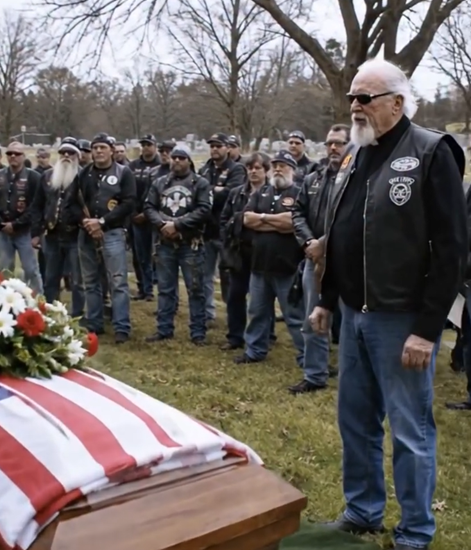
“Who are those men?” I whispered to my daughter as thirty motorcycles appeared near the cemetery entrance.
Their engines had interrupted the quiet atmosphere of my husband’s funeral. One by one, the riders parked, switched off their engines, and removed their helmets.
They were men of different ages. Some had gray hair and weathered faces. Others looked young enough to be my grandsons.
They wore leather jackets, heavy boots, and expressions I couldn’t quite understand.
My daughter, Anna, looked at them carefully before shaking her head.
“I don’t know, Mom,” she whispered. “I’ve never seen them before.”
Neither had I.
And yet, the way they walked toward my husband’s coffin made me wonder whether they knew something about Walter that I had never discovered during our forty-nine years of marriage.
I had no idea that their arrival would change the way I remembered the man I had loved for nearly half a century.
Six months have passed since that day, but I can still remember every detail.
I’m seventy-eight years old now. I have lived long enough to understand that people can surprise you, that grief arrives in unexpected waves, and that sometimes the people we think we know best still have stories we haven’t heard.
But nothing prepared me for what happened at Walter’s funeral.
My husband died at seventy-nine after a brief illness.
For forty-nine years, we had shared a home, raised our daughter, celebrated birthdays, argued over little things, and built the ordinary routines that eventually become the most precious parts of a marriage.
I knew how he liked his coffee.
I knew he disliked drinking it once it became cold, even though he sometimes forgot his cup on the kitchen table.
I knew he always carried peppermints in his coat pocket.
I knew he preferred reading on the porch in the late afternoon, when the sunlight softened and the birds began gathering near the garden.
And I knew that whenever Anna called him on his birthday, he would become unusually quiet after hanging up.
He never admitted it, but I knew he sometimes cried because he missed her, even though she lived close enough to visit.
Those were the little things that made Walter my husband.
He had been a history teacher at our local high school for forty years.
He wasn’t the kind of man who needed attention.
He rarely raised his voice, avoided unnecessary arguments, and believed that even the most difficult person deserved an opportunity to be heard.
He often told me that people were more complicated than the labels others gave them.
I remembered hearing those words countless times.
Sometimes I agreed with him.
Sometimes I told him he was too patient.
He would simply smile and return to whatever book he was reading.
After retirement, Walter settled into a quieter routine.
He spent time tending our garden, feeding the birds, reading books, and occasionally repairing things around the house.
He enjoyed the simple pleasures of life.
For years, I believed I knew exactly how he spent his days.
At least, I thought I did.
The morning of his funeral was cold and unusually quiet.
I had barely slept the previous night.
His absence was already visible in the smallest corners of our home.
His favorite chair was empty.
His reading glasses remained where he had left them.
His slippers were still beside the bed.
I kept looking at those familiar objects, almost expecting him to walk into the room and ask whether I had made coffee.
Instead, I had to prepare myself to say goodbye.
At the cemetery, Anna sat beside me and held my hand.
Only twelve people had come.
There were a few neighbors, two relatives, and some old friends from church.
I looked toward the entrance several times, hoping to recognize someone from Walter’s years at the school.
Forty years.